

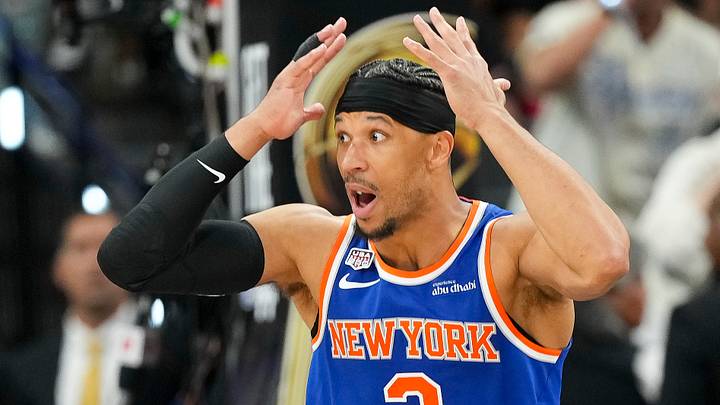
As much as we try to figure out how much Josh Hart will get in an extension with the New York Knicks, we can’t know for sure until the team settles on a new deal with Karl-Anthony Towns.
Indeed, the outside market might already be telling the Knicks what Hart is worth. But that doesn’t matter nearly as much as what Towns will be making in 2027-28.
The big man currently holds a $61 million player option for the season after this coming one. Given New York’s unwillingness to enter the second apron, it needs that number to come down if it wants to keep the starting five together.
Fortunately for the Knicks, Towns will definitely be making substantially less than his player option if and when he signs a new contract. Yet, without knowing just how much less, it’s almost impossible for them to hammer out an extension with Hart.
The bigger KAT’s discount, the more Josh Hart can make
Needing to take care of KAT first doesn’t automatically mean he’s more important than Hart. (Even though he is more important—on the court, anyway.) The order of operations is more about current contract structures.
Thanks to his player option, Towns has the power to decide whether he becomes a free agent in 2027. Hart, on the other hand, has a $22.4 million team option next summer. The Knicks can pick that up and keep him off the open market if the two sides fail to reach an extension. That inherently drives down the urgency with which they approach negotiations.
At the same time, New York also needs Towns’ deal to get done so it knows how to build out Hart’s next contract. The fundamental question at hand: Will Hart’s extension see him decline his team option, or will the Knicks have him pick it up?
League sources explained to The Athletic’s James L. Edwards III that having Hart pick up his team option and then extending him off it is the most reasonable course. That’s not necessarily true.
If Towns picks up his own player option and the Knicks keep Hart at $22.4 million, they’d be around $7 million below the second apron with at least four roster spots to fill. That wiggle room evaporates if they decide to keep Deuce McBride.
On the flip side, paying Hart $20-plus million in 2027-28 is a lot more manageable if Towns is making $40 or $50 million instead of $61 million. Heck, if KAT’s annual money drops low enough, the Knicks could raise Hart’s 2027-28 earnings and have his next contract decline year-over-year to increase their flexibility as they prepare to pay Jalen Brunson market value for the first time of his career.
The Knicks have options with Hart, but they need KAT to narrow them
Knowing how Hart is wired and how much he loves New York, he seems destined to work around whatever logistical hurdles the Knicks have to clear. Yet, this loyalty will be tested if he comes to find the Knicks need him to take another discount.
Maybe New York doesn’t need Hart to take less. Or perhaps it’ll need to lower his team option number, but be able to give him raises in subsequent years. The Knicks might decide to pick up his team option, and increase or decrease his annual salary from there. They could even opt to hold off on an extension until next summer.
Plenty of different paths are on the table. The one New York and Hart ultimately travel down is almost entirely contingent upon Towns’ next contact.
 Add us as a preferred source on Google