

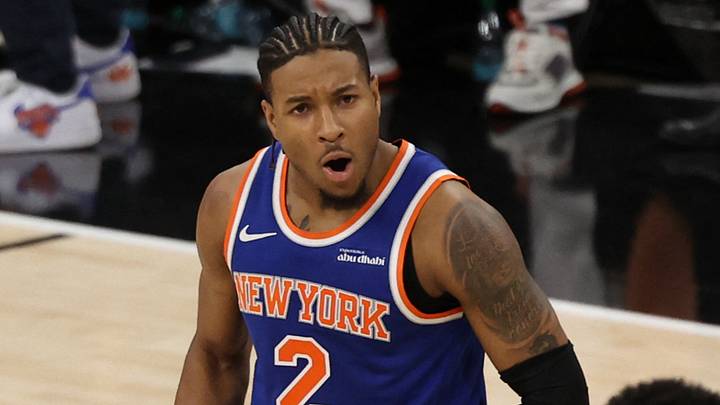
Even with free agency on his horizon, Deuce McBride should not be someone the New York Knicks are resigned to moving before next season’s trade deadline. At the same time, it never hurts to optimize anyone’s trade value.
Which is why the Knicks should sign McBride to an extension.
Now, you might have seen reports stating the 6’2” guard can no longer be jettisoned if he signs a new deal, because of the six-month restriction on veteran extensions. As our own Mark Nilon noted, however, this is not entirely true.
The Knicks can still extend McBride and then move him before the Feb. 11 trade deadline if his contract is for no longer than three additional years, starts at under 120 percent of the estimated average salary in 2027-28, and its salary over the life of the agreement doesn’t fluctuate by more than 5 percent in either direction.
If New York can lock him down on a deal that adheres to those terms, it could do wonders for his value in the event the front office decides to ship him out.
Teams interested in Deuce McBride could fear his free agency
Though free agency doesn’t feature as many changes of scenery these days, a player’s foray onto the open market still plays a part in how much teams are willing to trade for them. Any squad that acquires McBride now only gets one season with him before he can sell his services to the highest bidder. That window shrinks to a half-year or less if the Knicks wind up unloading him midstream.
This will invariably cost New York ground in negotiations. Interested suitors will play up the notion that McBride could be a rental. They are less likely to give up sufficient draft compensation or an ideal backup big man when they have to worry about losing him.
Even if McBride’s next squad doesn’t deem him an immediate flight risk, they won’t know how much he costs going forward. They can hope the market sets a team-friendly rate, but that’s ultimately just a hunch.
Signing McBride to an extension eradicates that uncertainty. His next team would know he’s under contract beyond 2026-27 for an additional two or three years. That doesn’t automatically mean they’ll surrender a juicy draft pick or prospect to get him, but it allows the Knicks to enter talks with leverage they don’t have now.
Extending Deuce McBride should also be pretty straightforward
The criteria any McBride extension must meet to remain trade-eligible sounds like a lot, and therefore a long shot. It’s actually not.
Sure, if he’s demanding a salary north of $20 million per year, it ruins everything. But he doesn’t have that kind of clout.
Small guards who can’t run your offense aren’t brokering huge paydays. McBride may be at the higher end of this archetype, but the idea he will sniff the league’s estimated average player salary in 2027-28 ($15.8 million) is farfetched.
This increases the likelihood New York can hash out an extension that keeps him trade-eligible. A three-year, $36 million pact that pays him a flat $12 million per season feels reasonable, and fits within the extend-and-trade constraints. It’s also a number that interested parties are more likely to flag as team-friendly than above-market.
Think of it this way: You’re heading the front office of an NBA team. Would you rather trade for McBride when he has one year and $4 million left on his deal, or when he has a total of four years and $40 million remaining?
Framed this way, the Knicks themselves should be jazzed about extending their homegrown guard. If they can’t move him this season, he’s more than tradeable at that number next summer.
Better still, a contract like this (or something similar) is enticing enough that maybe, just maybe, they’d prefer not to trade him at all.
 Add us as a preferred source on Google