

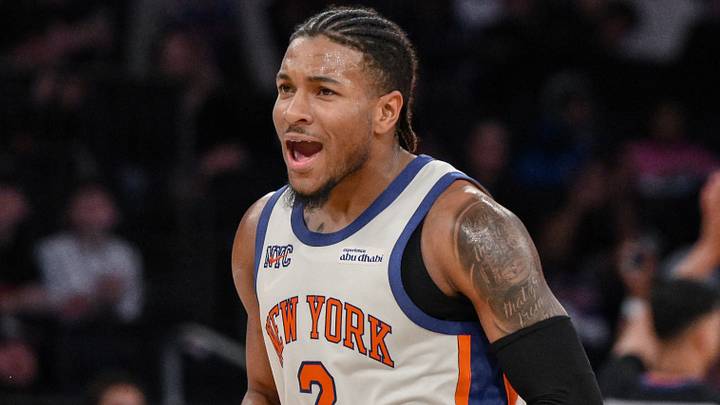
Despite the absence of any concrete rumors, we can reasonably assume the New York Knicks have Deuce McBride on the chopping block. They need a third big, have plenty of guards, and above all, tend to move players they don’t intend to pay before they reach free agency.
Conventional wisdom suggests that with McBride currently scheduled to hit the open market next summer, the Knicks will send him elsewhere between now and the February 11 trade deadline, rather than risk losing him for nothing over the offseason. After all, they seemingly have no plans to enter the second apron, and he’s bound to cost a pretty-ish penny to re-sign.
Except, what if he doesn’t? What if this whole “The Knicks can’t afford to keep McBride” is all much ado over absolutely nothing?
Deuce McBride’s archetype works against him
Perimeter players who tackle tough defensive assignments while making tons of threes are among the most sought after in the NBA. McBride seemingly falls into that bucket.
Over the past three seasons, he has rated in the 75th percentile or better of both three-pointers made per 75 possessions and defensive matchup difficulty, according to BBall-Index. Aaron Nesmith, Jalen Suggs, and Keyonte George are the only players who have done the same while clearing 1,000 minutes each year.
This is an impressive group for Deuce to join. Standing 6’2”, though, he’s also by far the smallest of the quartet. The bar for getting caps-lock PAID is always higher for three-and-D talents listed under 6’5”.
Keyonte George is listed at 6’4”, a much worse defender than McBride, and nevertheless in line for a handsome extension from the Utah Jazz. That technically undermines our premise.
Unlike Deuce, though, he is his team’s primary ball-handler. (Also, the two inches he has on McBride matter.) If you’re not the size of a wing and looking to get paid, you almost always have to check that box.
McBride does not. Among everyone who logged at least 1,000 minutes last season, he barely ranked in the top 150 of true usage, a metric that accounts for shot volume, turnovers, assists, and potential assists. As we’re about to see, this is not a recipe for getting paid.
Re-signing Deuce may cost less than the Knicks think
Only 12 total players last season, including McBride, handled above-average defensive assignments, posted true usage rates under 40, and stood no taller than 6’4”. Of those 12, just two made more than $6 million: Davion Mitchell ($11.6 million), and Gabe Vincent ($11.5 million), the latter of whom was considered a monster negative at his pay grade.
Mitchell’s pay grade likely represents McBride’s ceiling. And even that could be a stretch. He was paid to be a starter, and handles the ball more than Deuce.
Someone like Jordan Goodwin of the Phoenix Suns is a better analog for McBride. He’s slightly bigger, but not nearly on Deuce’s level as a shooter. He just signed a three-year, $19 million deal to stay in Phoenix.
All of this points to the Knicks being better off holding onto McBride through next season. At the very least, the bar for moving him needs to be pretty high. Because while he won’t get any cheaper than the $4 million he’s making now, he’s clearly not on course to get prohibitively expensive, either.
 Add us as a preferred source on Google