

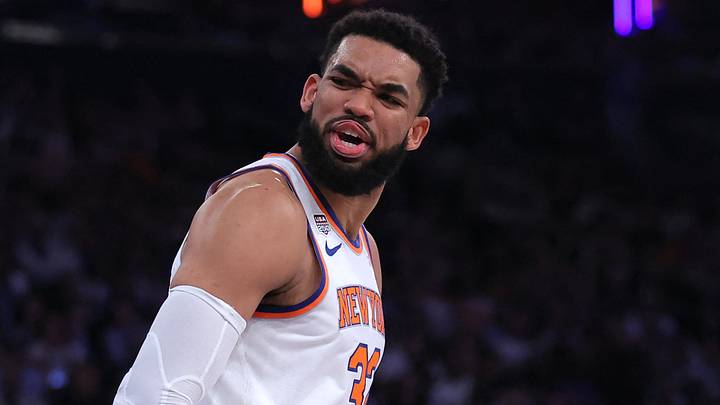
Karl-Anthony Towns’ extension eligibility has plenty of people on pins and needles. The concern, to be sure, isn’t that his player option next summer renders him a flight risk. It’s that the New York Knicks won’t be able to convince him to lower his $61 million salary in 2027-28 enough to keep the band together beyond this coming season.
Yet, as it turns out, neither the Knicks nor concerned fans should have much to worry about. Because while Towns taking substantially less than he’s on the books for now often gets framed as a concession, the truth is he may not have a choice.
The standard practice for superstar paydays isn’t what it used to be. The bar for max money entering your mid-30s is rising. This runs counter to Donovan Mitchell getting every penny in his extension, but primary ball-handlers have inherently more leverage.
As much as Towns did for the Knicks during their championship run, he doesn’t check that box. More importantly, when you look at how big-time contracts for other centers are panning out, you come to a startling conclusion.
Other big-money centers are costing Karl-Anthony Towns leverage
Towns is currently eligible for the same four-year, $273(ish) million extension the Cleveland Cavaliers gave to Mitchell. After what he did to Victor Wembanyama in the NBA Finals, he and his camp would be well within their rights to request the whole kit and kaboodle.
They’re just not going to get it.
Backing up the Brink’s truck for centers around Towns’ age isn’t working out for most teams. Five other centers are currently on the books in 2027-28 for over $48 million: Domantas Sabonis ($48.6 million), Bam Adebayo ($53.4 million), Joel Embiid ($62.6 million), Anthony Davis ($62.8 million), and Nikola Jokic ($62.8 million). Out of this group, Jokic is the only one definitively worth his paygrade.
Adebayo has a case, but it’s not hard to pick apart. Everyone else’s deal all the way under water.
Knowing how New York’s current front office operates, team president Leon Rose and crew aren’t going to put themselves in a similar situation with any Towns extension. A new deal would kick in during his age-32 campaign, and potentially run all the way through his age-35 season. Towns isn’t going to be worth 35 percent of the salary cap for the entire life of it. He probably won’t even be worth 30 percent of it by the end.
Granted, it only takes one other team to decide KAT deserves a max payday. Good luck spotting the one prepared to go that far. Even the most shortsighted and incompetent organizations understand the financial reckoning others are facing with their lucratively paid big men. It would be genuinely shocking if Towns reached free agency, and had a max offer waiting for him next summer.
All of this is good news for the Knicks
Even if a possible disconnect between Towns and the Knicks forces negotiations to drag on, New York is the party most likely to come out ahead—perhaps more so than anyone envisioned.
Rudy Gobert’s three-year, $109.5 million extension is being floated as a loose analog for what Towns could sign. Locking KAT down for an average of 22 percent of the salary cap would be a coup, and if we’re being honest, is pretty unlikely. His offensive skill set ensures he’ll be in higher demand than Gobert.
Still, the overarching sentiment stands.
Instead of wondering whether Towns’ next deal can average around $50 million per year instead of $60-plus million, it’s probably time to recognize it could hover around $45 million, if not less—not just because KAT is willing to take a substantial discount, but because relative to how other largesse deals for centers are looking, this may not constitute a discount at all.
 Add us as a preferred source on Google