

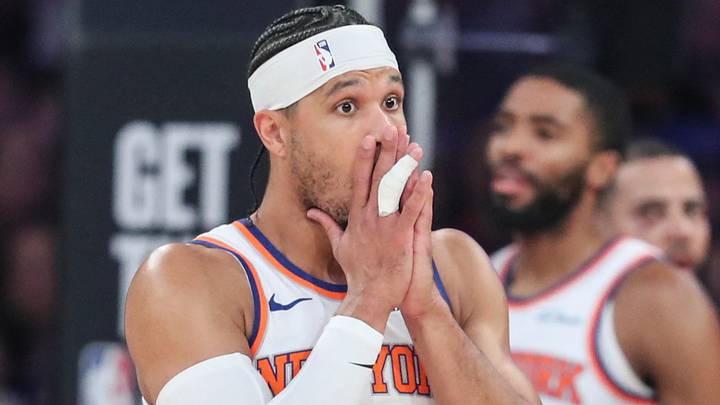
Josh Hart is officially eligible to sign an extension with the New York Knicks, and the price it costs to retain him long term will say more about the team’s desire to stick together than any deal we’ve seen since Jalen Brunson made the mother of all concessions.
And yes, this includes the looming Karl-Anthony Towns extensions negotiations.
Many have pegged the big man’s next contract as an organizational inflection point. They are not wrong. The Knicks are so far refusing to enter the second apron. Keeping this core together will require key players taking less. Brunson has already done his part. On some level, Mikal Bridges did, too.
With a $61 million player option for 2027-28, Towns has the ability to cut New York’s operating costs more than anyone. Having him decline it, and sign a longer deal at a lower annual number is the hope. But Hart’s willingness to take less while already making much less will be the bigger test of New York’s team-first, “No sacrifice, no victory” championship formula.
Karl-Anthony Towns’ extension isn’t really an inflection point
While Towns’ appetite for taking a “discount” remains unknown, it won’t necessarily prove much at all. We can’t even be sure signing at a smaller number will constitute a discount.
The star-contract landscape is changing. Brunson is among those who helped shift it. Big names may not only take less money more often, but the bar for max deals is rising.
Just as the Boston Celtics didn’t want to pay Jaylen Brown top dollar, the free-agency landscape could dictate that Towns isn’t worth $60-plus million per year entering his mid-30s.
This brings us back to Hart. His $22.4 million team option for 2027-28 projects to be 12.9 percent of the salary cap. That is right in line with his value as a combo wing defender, ball-mover, paint attacker, bloodthirsty rebounder, and 50-50-ball chaser. It is also within the ballpark of what Dillon Brooks just got from the Phoenix Suns.
Josh Hart’s number will say everything about the Knicks’ culture
Best of luck to anyone arguing that Hart is less valuable to the Knicks than the man who wears sunglasses indoors is to the Suns. Especially when Brooks’ three-year, $73 million extension runs through his age-34 season. Hart is about to enter his age-31 campaign, so any extension will be following a near-identical career timeline, too.
Not surprisingly, Brooks’ extension was used as a benchmark for Hart’s next deal when The Athletic’s James L. Edwards III spoke with executives around the league. These numbers are hardly egregious. But the Knicks have not assembled their championship core on the back of at-market deals. They have convinced—and been fortunate enough—to land team-friendly contracts.
From Brunson and Bridges to Deuce McBride and Landry Shamet, New York almost always wins negotiations. OG Anunoby’s five-year deal is the lone exception, and it was still below the max.
Even Hart falls under this umbrella. He picked up his $13 million player option in 2023-24 before signing an extension to help the Knicks preserve flexibility. That time, however, the promise of another at-market deal awaited him. The same will not be true now.
Knowing this, Hart could refuse to sign an extension. Or the Knicks could offer him one deemed fair rather than highway robbery. They could also pick up his team option in 2027-28, and kick the decision-making can down the road.
Then, of course, there is the other scenario: Hart taking less than he’s worth, even though he’s not sniffing KAT’s pay grade. If this happens, it’ll prove the Knicks’ core isn’t just satisfied with one championship. And not only would it show they want to contend for more, but it’ll cement what many already suspect: that they want to chase those titles together, even if it comes at a personal cost.
 Add us as a preferred source on Google