

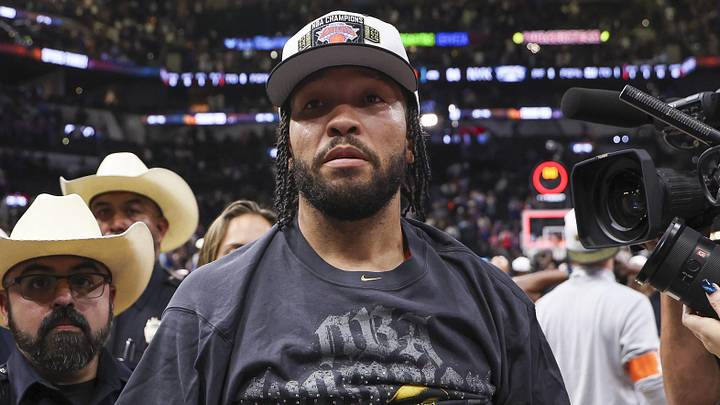
Jalen Brunson did the New York Knicks a $50 million favor when he signed his current four-year, $156.5 million extension. Now, after leading the franchise to its first title in 53 years, his decision to play on a below-market contract could be one that catches on among other NBA superstars who understand the realities of today’s team-building challenges.
Sustaining championship-level rosters is harder than ever under the current collective bargaining agreement. The implementation of the second-apron threshold has fundamentally changed how organizations allocate their money. If your payroll gets high enough, you aren’t just on the hook for steeper luxury-tax bills. You can lose access to the mid-level exception, aggregating salaries in trades, and the ability to take back more money than you send out in deals, among a host of other restrictions.
Working within these margins has, for the most part, killed the three-max star model. Teams who embrace it inevitably end up thin (Philadelphia 76ers), or speeding toward difficult cost-cutting decisions (Oklahoma City Thunder).
New York has so far avoided this fate, almost entirely thanks to Brunson.
Jalen Brunson already helped the Knicks float this score
Had Brunson waited to sign his new deal until the summer of 2025, a four-year max would have run $207.8 million. That is over $50 million more than he ultimately accepted. Even if you discount the final season of his contract because of the player option, Brunson saved the team a total of $37-plus million over three years. That’s more than $12 million per season.
The Knicks have already benefited from this discount. They finished $250,000 beneath the second apron this past season. That’s not possible without Brunson checking in so far below market value.
If he waited to sign a full-blown max, New York would have been a second-apron squad, and disallowed from using the mini mid-level exception. Sure, the Knicks burned the mini MLE on Guerschon Yabusele, who didn’t work out. But they turned him into Jose Alvarado, who proved critical to their historical comeback win during Game 4 of the NBA Finals.
Now, Brunson’s steep discount won’t keep New York out of the second apron much longer. It’s slated to cross the threshold next season unless it parts ways with Mitchell Robinson, and potentially Landry Shamet or Alvarado himself.
Still, Brunson’s salary helped delay this decision to enter the second apron. If the Knicks crossed it this past season, they might not be open to paying into it for 2026-27, or 2027-28. His decision may have very well bought this core an extra year or two together.
Other superstars may need to take notice
“This CBA effectively gives star players a binary choice,” writes Bryan Toporek for Forbes. “Do you want to maximize your earning potential or your championship equity? You can't have it both ways anymore.”
We have already seen some teams move off players who weren’t willing to accept discounted paydays. The Los Angeles Clippers let Paul George sign with the Sixers last summer, and then traded contract-year James Harden to the Cleveland Cavaliers this past season.
While it seems unfair to put the onus on the players to accept less money, the rules in place today were collectively bargained. Even if teams pushed for the current cap environment, the players association accepted it. They must now live with the consequences.
Extension-eligible big-timers like Nikola Jokic, Donovan Mitchell and the soon-to-be traded Giannis Antetokounmpo all have a choice to make as a result: Do they sign the four-year, $270-plus million deals that will eventually be available to them? Or do they take a substantial pay cut in hopes it helps their teams retain and/or add talent around them?
Brunson chose the latter. It resulted in a championship. Maybe it won't happen this summer. Or next. But it feels like only a matter of time before another star follows in his footsteps.
 Add us as a preferred source on Google