

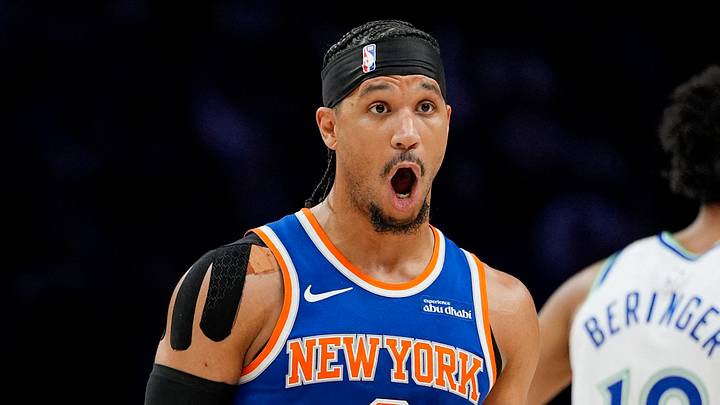
While the New York Knicks have not always expertly handled negotiations with their current crop of extension-eligible players, their hardball stance is panning out when it comes to Josh Hart. Between the injuries he’s dealing with and the offensive up-and-downs he’s laboring through, he’s making their argument to hold off on hammering out a new deal for them.
This is a cold, callous way of looking at the future of someone integral to ending the Knicks’ championship drought. It is especially difficult to consider knowing that he’s playing through pain—more so than we realized.
Hart has missed time with an ankle injury, and also revealed that he battled a weeks-long calf issue back in September. More recently, he told the New York Post’s Stefan Bondy that he’s playing through pain in his shoulder.
This all ties back to the sacrifices Hart has made for the team. He’s even seen his on-ball share of the offense drop as the Knicks assign more volume to Karl-Anthony Towns.
To that end, Bondy argues that leaving Hart billowing in the wind with a non-guaranteed deal for next season (team option) is anathema to the championship culture. He notes that owner James Dolan asked the players to sacrifice ahead of last year’s postseason.
“The players followed up,” Bondy writes. “The sacrifice wasn’t reciprocated. Instead, there’s a wait-and-see approach with their contract extensions.”
The logic here is understandable. It’s also not how the Knicks can or should conduct business.
The Knicks can’t afford to pay Josh Hart for what he’s already done
Hart turns 32 in March, and since joining the Knicks, he ranks third in total minutes played across both the regular season and playoffs, trailing only teammates Mikal Bridges and Jalen Brunson. That is an admirable workload—and also why New York must proceed with caution.
Depending on length, Hart’s next deal will take him through his mid-30s. Even if he’s fully healthy, we are probably talking about his post-prime years. That doesn’t necessarily mean he’ll be worth less than his $22.4 million team option moving forward, but it could.
The thing is, he’s not fully healthy. Not right now. And it’s impossible for the Knicks to tell whether his current level of play is a symptom of what he’s battling, or a harbinger of decline.
This is where people (myself included) get caught up in track records versus projections. Hart was a critical component to a title team, but the Knicks can’t afford to pay him based on that. They have to compensate him according to the player he is now, and will be moving forward.
Red flags abound at the moment. Hart is shooting a career low on twos (43.2 percent) and threes (27.4 percent). While the Knicks have won the minutes he’s played overall, their offensive rating dips by 9.2 points per 100 possessions with him on the floor. He is also part of why New York struggles to score so much when Towns is out of the game.
Maybe all of this proves temporary. Even if it does, some of Hart’s limitations will remain. Defenses won’t treat him like a five-alarm fire from deep even when he’s lighting it up. We have already seen Mike Brown go away from him in certain crunch-time situations.
Josh Hart remains important, but the NBA is business
This isn’t meant to be a takedown of Hart. Yours truly hopes he retires donning orange and blue. But the NBA’s parity era is ruthless. We have seen a handful of contenders shorten their own windows by getting too high on their own supply.
Look no further than the topsy-turvy Denver Nuggets. They didn’t negotiate in their extensions for Jamal Murray or Aaron Gordon, and didn’t play hardball with Christian Braun. Those missteps have left them unable to effectively replenish the pipeline around Nikola Jokić, and also catalyzed certain cost-cutting moves, such as the Michael Porter Jr. and Peyton Watson trades.
The Knicks are attempting to be more meticulous in how they retain this core. Dolan has not helped matters with his bogus comments and second-apron aversion. But even if he never addresses it, there’s a chance the Leon Rose-led front office handles all New York’s extension situations with the same conservatism.
This team understands the key to sustainability is a certain level of flexibility. Having a contract on the books that won't age well undermines that.
Time will tell whether this overarching approach is the right call. The Knicks are certainly playing with fire when it comes to Towns.
So far, however, Hart is a different story. Whether it’s injuries, a temporary rut or actual regression, the way he’s playing right now is validating New York’s concern about the future—and the all-business stance in which it’s resulted.
 Add us as a preferred source on Google