

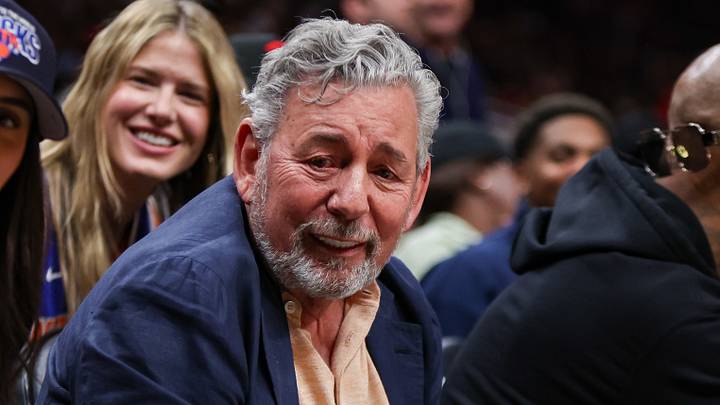
Boatloads of keyboard strokes have been burned explaining why Jame Dolan is the New York Knicks’ biggest roadblock to keeping the current core together past this season. Not enough space, though, is dedicated to pointing out that his grounds for avoiding the second apron don’t make any sense.
Just in case you needed further confirmation that Dolan is at the heart of this issue, here it comes. Speaking during an episode of the Game Theory podcast with Sam Vecenie, James L. Edwards III of The Athletic explained that Karl-Anthony Towns’ frustration over the absence of an extension seems directed toward the Big Kazoo rather than the front office:
“I don’t think KAT’s irritability with the situation is directed at the front office. Him and Leon Rose go way back. If there were no restraints, I think this would be resolved. But the owner said no second apron. You’ve heard guys talk about how they were surprised they lost Mitch[ell Robinson]. Guys know what’s going on.”
As you may recall, Dolan previously said that going into the second apron would be “suicidal.” And it’s allegedly not because of the money. Or so he says. "I'll write as big of a check as possible,” he told WFAN at the time, “but I can't write a check into the second apron.”
The Knicks are already navigating most of the second-apron restrictions
If money isn’t the primary issue, we have to assume the roster-building restrictions are what have Dolan’s goatee in a knot. To be fair, these would be legitimate concerns…if the Knicks weren’t already into the first apron.
The difference in restrictions between the two aprons isn’t that stark. And since the Knicks are within $1 million of the second apron, they’re already abiding by those souped-up limitations anyway.
Consider some of the key second-apron constraints, and how they compare to the first apron:
- Second apron teams cannot take back more money in trades than they receive. That’s a limitation of the first apron, too.
- Second apron teams cannot use preexisting trade exceptions. This goes for first apron squads as well.
- Second apron teams cannot sign a waived player who was initially making more than the non-taxpayer mid-level exception ($15.1 million). You’re never going to believe this, but that holds true for first-apron squads as well.
- Second apron teams cannot use the mini mid-level exception. First apron teams are allowed to use it. But guess what? The Knicks didn’t use the mini mid-level this year.
- Second apron teams cannot sign-and-trade their own free agents to other squads. Thank god the Knicks avoided this restriction so they could sign-and-trade Mitchell Robinson to the Boston Celtics. Oh, wait, they didn’t do that. Never mind!
- Second apron team cannot combine multiple salaries in a trade. This option is currently available to the Knicks. But ask yourself, what would you have preferred this season: being able to trade Pacome Dadiet and Miles McBride in the same package, or having Mitchell Robinson on the roster? What’s more, any trade the Knicks make is going to be small-time unless they move a core player. You’re not shrinking the pool of options by that much if you can only trade Dadiet as opposed pairing him with another salary. And if you are moving a core player, every member of the starting five earns over $20 million, so you’ll have plenty of salary-matching power. Finally, you can still combine salaries in a trade if you then finish the deal below the second apron.
- Second apron teams are prohibited from trading their first-round pick seven years into the future. Unless you think the Knicks should be offloading their 2033 first-round pick to acquire a [checks notes] backup center, this restriction would also be a non-issue. This restriction can also be lifted if you remain out of the second apron in three of the next four years. On top of that, it only applies to one pick. For example, the Boston Celtics finished inside the second apron during the 2024-25 season. Their 2032 first-round pick was and remains frozen as a result. But they are currently allowed to trade their 2033 first-round pick, since they’re not in the second apron.
- Second apron teams can see their “frozen” pick get moved to the end of the first round. This restriction only kicks in if the Knicks stay inside the second apron three years in a four-year span.
- Second apron teams cannot include cash in a trade. After some complex math, it turns out the Knicks have spent exactly $0 in trades since the league flipped to the 2026-27 calendar. The season is still young, but they sent out under $1 million in trades last year.
Other limitations are baked into the second-arpon experience, such as the inability to use newly-created traded player exceptions. But again, when you’re as deep into the first apron as the Knicks have been each of the past two seasons, this doesn’t especially matter.
James Dolan’s second apron stubbornness doesn’t add up
A charitable interpretation of Dolan’s second apron refusal would suggest he doesn’t understand the insignificant differences facing the Knicks. Yet, even if he doesn’t, New York’s front office does. Rose and cap-guru Brock Aller could lay them out to him, and probably have.
Dolan could also be fibbing when he says “I’ll write as big of a check as possible.” Then again, for all his many faults and foibles as an owner, he’s never shied from paying his players. On top of that, the NBA’s luxury tax-band system is, to a point, less financially punitive than before.
This whole second apron rigmarole could be a cover for the Knicks’ front office not wanting to pay KAT over $50 million per year into his mid 30s. But while that logic makes some sense, this would be an asinine way of veiling that intention.
Perhaps Dolan is simply being petty. He hates the league’s revenue-sharing program, and could be attempting to send a message by risking the fate of a contender with his second-apron decree.
Dolan’s true reasoning behind this, quite frankly, absurd stance is anyone’s guess. But if he expects us to believe it’s about preserving roster flexibility and transaction optionality, he’s kidding himself. And nobody, neither fans nor the media, should allow themselves to buy into whatever flimsy logic he’s attempting to peddle.
 Add us as a preferred source on Google