

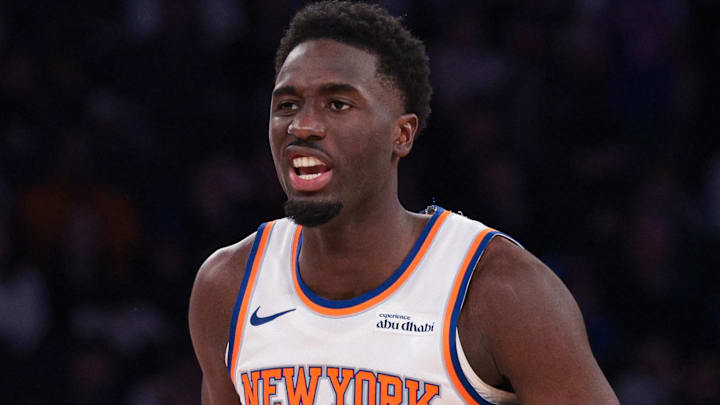
Mohamed Diawara’s emergence as a real rotation player is an unequivocally great development for the 2025-26 New York Knicks. It is also, without question, an incredibly expensive development for the 2026-27 Knicks.
The 20-year-old rookie is set to be a restricted free agent. New York does not have to worry about another team outbidding it for him. If the Knicks want to keep him, which they should, they have the means to do so.
It’ll just cost them any genuine shot at once again side-stepping the second apron—and foist them into unchartered territory that severely limits their ability to improve elsewhere.
The Knicks have to pay more than just Mohamed Diawara
Diawara is not the only key member of the rotation in need of a new deal. Landry Shamet and Mitchell Robinson are hitting the open market as well, and Jose Alvarado will join them if he declines his player option.
The Knicks, again, needn’t lose sleep over having the ability to pay them. Various versions of Bird rights permit them to offer whatever it takes to retain any or every single of them. But that isn’t going to come cheap.
Robinson’s scattershot availability works against him, but it’ll be a miracle if he doesn’t get a raise off the $13 million he’s earning this season. Shamet will hit the market after establishing himself as a First Team All-Bang-For-Your-Buck bargain. Alvarado was already worth more than the $4.5 million player option he has before joining the Knicks. His impact since arriving in New York drives this home even further.
Now, the Knicks must add Diawara to their list of could-be-pricey-to-retain names. His salary next season is capped at the non-taxpayer’s mid-level exception ($15.1 million). He almost assuredly isn’t getting that much. But anything over the rookie minimum that he’s making now means a great deal to a payroll with limited wiggle room.
Entering the second apron isn’t the end of the world, but it’s problematic
New York will enter the summer with $17.6 million in runway beneath the second apron. This presumes Alvarado exercises his player option. It does not factor in new deals for Diawara, Shamet, and/or Robinson.
Retaining almost any combination of these four players will likely vault the Knicks inside the second apron. That isn’t totally taboo, but it creates challenges if the team wants to make changes elsewhere.
We are not just talking about potentially pursuing Giannis Antetokounmpo, either. That gets harder because the Knicks can’t aggregate salaries, or take back more money than they receive as part of any trade. But entering the second apron also costs them access to the mini mid-level exception, leaving them with only minimum contracts to offer.
This won’t incite much regret after what happened with Guerschon Yabusele. Teams aren’t guaranteed to hit home runs with the mini MLE. Still, it can be an integral roster-building tool when you don’t have anything else at your disposal.
Paying Diawara, Shamet, Robinson, and (maybe) Alvarado currently feels essential. Yet, blowing past the second apron to run back the same exact core gets awkward if the Knicks don’t meet their championship-or-bust standard.
Then again, maybe this is jumping the shark. There’s no way New York looks the same if it flames out of the playoffs. The decision of who to pay could be made for the Knicks.
If it’s not, if they enter the offseason believing this exact group still has what it takes, retaining everyone is going to cost them more than they could’ve imagined—in no small part thanks to a Diawara breakout nobody saw coming.
 Add us as a preferred source on Google