

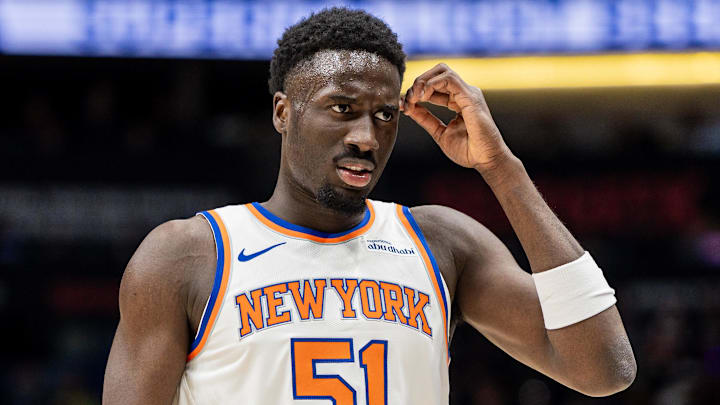
Mohamed Diawara’s recent breakout is taking place amid an undercurrent of light panic. After signing a one-year deal, he will be a free agent this summer, hitting the open market without full Bird rights. Since the New York Knicks are expected to enter the second apron next season, this typically wouldn’t bode well for their ability to pay him.
Yet, thanks to what’s become known as the Gilbert Arenas Rule, this is a non-issue. The Knicks will be able to re-sign Diawara if they want to keep him.
And right now, with the way he’s playing, they shouldn’t just want to keep him. They need to keep him.
The Knicks do not have to worry about another team stealing Mohamed Diawara
Diawara will be a restricted free agent when this season ends. That typically allows his incumbent team (i.e. the Knicks) to match any offer he receives.
Prior to the 2005 CBA, though, this wasn’t exactly the case.
Restricted free agents with just one year of experience are still subject to non-Bird rights. These allow squads to re-sign their own free agents for up to 120 percent of their current salary. If that isn’t enough, they must use cap space, a mid-level exception, or the room exception to hash out a deal.
At this rate, non-Bird rights on Diawara mean nothing to the Knicks. A 120 percent raise comes out to around $1.5 million. That’s less than the minimum salary next season for players with one year of experience, which projects to clock in at a little under $2.1 million.
This would usually leave the Knicks up You-Know-What’s Creek without a paddle. They have no prayer of carving out cap space, and won’t have any exceptions to spend if they wind up re-signing Mitchell Robinson.
Enter the Gilbert Arenas Rule.
After its namesake left the Golden State Warriors for the Washington Wizards as a restricted free agent with two years of experience, the league implemented this provision to make it easier for teams to retain their own new-to-the-NBA hidden gems. As a result, rival teams can’t offer Diawara a starting salary north of the non-taxpayer’s mid-level exception ($15.1 million next season), and the Knicks would own the right to match.
Make no mistake, this is a big deal for the Knicks
Now, there are workarounds to the Gilbert Arenas Rule that can make contracts queasy for New York to match. While teams are limited to how much they can pay Diawara for the first two years of his deal, they can exponentially inflate his salary in Years 3 and 4 to make it less palatable for the Knicks to match.
New York experienced this firsthand when Jeremy Lin left for the Houston Rockets in 2012. Fortunately, it’s unlikely something similar happens again.
As promising as Diawara looks, particularly on the defensive end, he’s a 20-year-old with fewer than 500 minutes of NBA experience. His court time might tick up, but skepticism will remain. He could finish the season shooting over 39 percent from three, and most still won’t trust his range.
Scant few teams will also have cap space this summer. Plenty will have the full mid-level exception, but the odds of them gambling a huge chunk of it, let alone all of it, on an unknown are beyond slim.
Still, there is a huge gap between “the entire MLE” and “the league minimum.” A team could feasibly come in with an offer worth a little more than the mini MLE, which would exceed New York’s spending power under normal circumstances.
Because Diawara is so early into his career, these are far from normal circumstances. So while he may cost the Knicks more to retain than they expect, the fact they can re-sign him at all is a win by itself.
 Add us as a preferred source on Google