

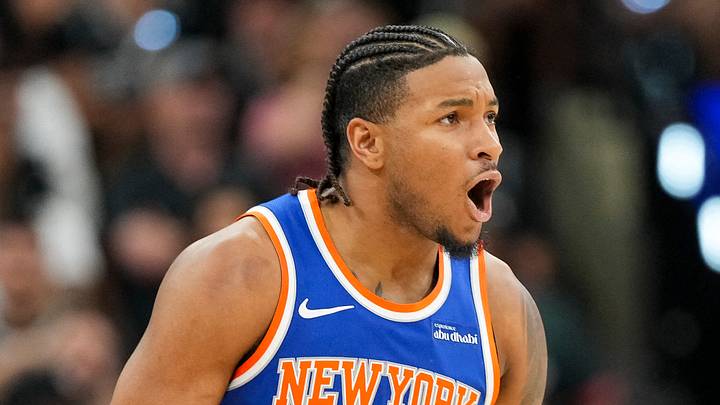
Miles McBride’s future with the New York Knicks has so far been boiled down to finances. Paying him past this season will almost certainly take them into the second apron. As far we know, James Dolan will not let his team go into the second apron. Ergo, McBride will be traded.
Yet the calculus isn’t that simple. It includes a number of other factors—the most important of which is the Knicks’ big-man rotation.
With the exception of fleeting first-half brilliance from Andre Drummond on opening night, nothing about the state of the center position has changed. Mitchell Robinson is a big-time loss, and barring an eventual breakout from James Wiseman, New York will need to make an upgrade at the backup-center spot to playoff-proof its rotation.
Holding out hope for this to change is fine. It’s early. But the Knicks already found out Drummond can be unplayable against the Celtics, and projects like James Wiseman don’t often pop after the better part of a decade in the league.
If it turns out the Knicks need to trade for a big, the move they eventually make looms as a larger threat to McBride’s future than the team’s second-apron allergen.
Miles McBride is the Knicks’ most natural trade candidate
Acquiring another center or anyone else isn’t a mindless endeavor for the Knicks. They can’t take back more money in trades than they send out, and their largest matching salary outside the starting five belongs to Landry Shamet, who isn’t even making $5.6 million.
After him, it’s Jose Alvarado at $4.9 million, followed by McBride at just a hair under $4 million. Even if the Knicks stack multiple salaries on top of one another, they’ll be hard-pressed to land someone making north of $8 million or $9 million.
Complicated still, Alvarado isn’t trade-eligible until December 15. Shamet can’t be dealt until January 15. McBride, on the other hand, joins Pacome Dadiet and Tyler Kolek as the only non-starters on the roster who are trade-eligible before December.
To that end, Dadiet figures to be in any deal the Knicks make. That was just about the only reason to keep him past training camp. But his value is rooted in his $3 million, and nothing more. New York will have to attach assets to his deal for a team to bite, and $3 million on its own doesn’t open a world of options anyway.
Bake in the fact this roster is inherently guard-heavy, and you come to the realization that McBride is the Knicks’ only trade-eligible non-starter with any real standalone value. If they want to make a move for a big or someone else, it will almost definitely have to include him—which isn’t necessarily the right call.
The Knicks can’t treat Deuce McBride as expendable
Sentiment toward McBride skewed negative after opening night. He didn’t shoot the ball well, and it appeared both Shamet and Alvarado were ahead of him in the rotation.
That all changed in Friday’s loss to Boston. McBride’s long-distance shooting was a lifeline, and his defensive workload stood out.
The Knicks can’t punt on his upside without thinking twice. Though a lot hinges on Karl-Anthony Towns’ next price point, the combination of a salary-cap bump and a free-agent market that doesn’t often value undersized guards who can’t run the offense could make McBride more affordable than many realize.
Giving up the chance to keep him for another big is especially fraught. Yes, the Knicks need one. But there is almost no world in which KAT’s backup is more important to a postseason rotation than McBride. If Mikal Bridges or Josh Hart is in a slump, there’s at least a slim possibility Deuce could close.
At its core, then, the McBride dilemma isn’t a financial one. For a team singularly focused on winning another title right now, his future boils down to whether the Knicks think they can be better, or at least more balanced, without him.
 Add us as a preferred source on Google