

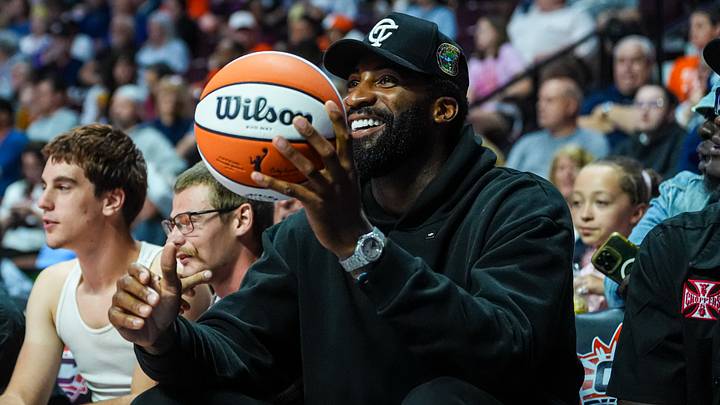
Trade season in the NBA unofficially, but also kind of officially, begins on December 15. That’s when a majority of the contracts signed by free agents over the summer become eligible to be dealt. When the New York Knicks inevitably make their move for another big man, they would be wise to complete it much sooner, when the competition won’t be as stiff.
Yes, we’re talking trades already. We have no choice. Even with James Wiseman, Drew Eubanks, and Tony Bradley on the training camp roster, the Knicks do not have their permanent third center on the board.
To be brutally honest, they may not even have Karl-Anthony Towns’ primary playoff backup on the docket just yet. Andre Drummond was a fine pickup at the minimum, but his defensive limitations will render him a liability in many postseason matchups. The Knicks know this firsthand; he barely played during their second-round romp over the Philadelphia 76ers.
Some type of trade is coming. The earlier it does, the better it stands to be for New York.
The Knicks need to strike while other teams remain in wait-and-see mode
Absent trade demands from big names, not many deals go down before December 15. Not only are teams waiting for the market available-player rist to expand, but require reps to understand what they need most, and for those options to become gettable.
The Knicks are different. They don’t have to wonder what they need. They are returning over 80 percent of the rotation from a championship roster. Mitchell Robinson and Ariel Hukporti are the only notable players to leave. Both are centers. One-plus-one equals two, and all that.
Still, knowing what this team needs most is just part of the battle. New York also needs the assets and tradeable salaries to complete a deal.
Working within the second-apron confines makes the money difficult. The Knicks can’t flip for marquee names without sending out a core player. That limits them to using Pacome Dadiet’s $2.9 million salary, and/or Deuce McBride’s expiring $4 million contract.
Those financial limits aren’t ideal. But they are workable. Outbidding other teams for big men is much harder.
Stockpiling second-round picks will help swing a deal. Those only go so far, though. Second-string bigs shouldn’t fetch a ton, but prospective targets like Moussa Diabate, Dylan Cardwell, Zach Edey, Kel’el Ware, and Yves Missi, among others, won’t be shipped out for nothing.
New York needs to beat rivals to the punch
Once more suitors get involved, the Knicks will be at a disadvantage. They have no blue-chip prospects to dangle. McBride’s pending free agency could cap his value. (The idea of trading who might be their sixth-best player for a second- or third-string center is also a little icky.) And of course, they can’t trade a first-round pick before 2033—a selection they should not, under any circumstance, move to land a bench player.
In lieu of the ability to outbid rivals, acting early is New York’s market efficiency. While other squads bide their time for clarity and trade-eligibility, the Knicks should have no qualms about dangling seconds and bench salary to push a pre-December deal over the hump. That’s the luxury of knowing who you are, and what you need.
This isn’t to imply that possible “sellers” are ready to unload talent now, or that they’ll accept pennies on the dollar prior to the peak of trade season. But there’s a difference between waiting out the market for better offers on marquee names versus role players.
Consider the Sacramento Kings. It makes sense to keep Domantas Sabonis rather than flip him for next to nothing, if not a net-negative return. You can talk yourself into him playing well enough to foment aggressive interest.
Dylan Cardwell is a different story. He is cheap, relatively young, and versatile on defense, but has just 44 games of NBA experience under his belt. He also finds himself behind both Sabonis and Maxime Raynaud in the rotation, and could tumble beneath Precious Achiuwa, too. That’s a name the Kings might consider moving without waiting for trade season.
This is just one hypothetical in a long line of them. More broadly, teams that profile as buyers don’t usually act before December, the New Year, or even February 1. The willingness to go against that grain can be an asset unto itself, unburdening teams from the throes of fiercer competition—something the Knicks can be, should be, and quite frankly, need to be interested in.
 Add us as a preferred source on Google