

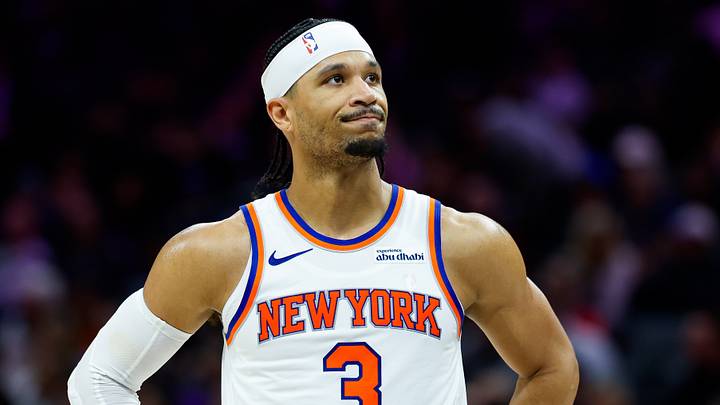
Josh Hart is now eligible to sign an extension with the New York Knicks that can be worth up to four years and $131.2 million. While it’s clear he won’t be getting anywhere near that much, some of the projections being thrown around would probably price him out of the Big Apple.
James L. Edwards III of The Athletic recently dug into what a Hart extension might look like. He notes that the 31-year-old could take a below-market deal, since that’s what some of his teammates, including Jalen Brunson, have done. But he also name-checks Dillon Brooks and Derrick White as two players to whom Hart has comparable value.
Brooks just signed a three-year, $73 million deal that kicks in during the 2027-28 season, and starts at roughly $22.5 million. White, meanwhile, is in the middle of a four-year, $118 million extension that will pay him $30.3 million, $32.6 million, and $34.8 million in each of the next three seasons.
To be sure, Edwards wasn’t making a prediction by throwing out these agreements. He’s just noting that Hart could view himself in the same vein, and chase a $25-plus-million-per-year payday.
Yet, even more optimistic projections for the combo wing’s next extension could give the Knicks problems. Unless that changes, New York may be better off letting next summer’s market decide how much Hart is actually worth.
Even the cheapest version of Josh Hart will be tough for the Knicks to afford
Edwards spoke with a couple of league sources who floated an extension that pays Hart somewhere between $18 and $20 million a year annually as an outcome that juggles realism with preserving the Knicks’ flexibility. This feels close to ideal in a vacuum. But New York’s payroll doesn’t exist in one.
Owner James Dolan’s refusal to enter the second apron puts the Knicks in a bind. They can’t just think about next summer, when they’re within $8 million of the second apron with just 10 players (including Hart) on the books. They have to plan for 2028-29, when Brunson’s salary could jump from $40.9 million (in the previous season) to $63.9 million.
Keeping Hart at even $18 million per year could prove difficult under those circumstances. That would be close to $4.5 million less than his $22.4 team option for next season. But even if Karl-Anthony Towns winds up taking his own sweetheart deal, the combined savings are unlikely to offset Brunson’s (presumed) max-contract jump.
This doesn’t even take into account other talent the Knicks will have to pay. Deuce McBride is a free agent next summer, and OG Anunoby has a player option in 2028-29, the year that Brunson’s salary is expected to skyrocket.
New York may have to make an uncomfortable Josh Hart decision
Using Dillon Brooks and Derrick White as benchmarks for Hart’s next contract is fair. The thing is, if he wants that much money, the Knicks may have to pass on signing him to an extension altogether.
That doesn’t mean Hart will walk, or be traded. Financially speaking, New York would just be better off letting the outside market set his rate.
Yes, combo wings who pass, dribble, defense, and rebound remain in demand. But teams aren’t throwing around money on outside free agents like they did years ago. Peyton Watson is the only combo wing this summer who signed a contract that pays him more, on average, than $17 million a year. Tari Eason was the second-most expensive combo wing, and the Houston Rockets locked him down at an average annual value of $16.3 million.
Hart has accomplished more than both of these players. Heading into his age-31 season, he’s also much older. Rival teams most likely aren’t breaking the bank for Hart next summer or the one after as he enters his mid-30s.
This is why using anyone as an analog for Hart’s future misses the mark. The Knicks are at a different point of their competitive life cycle than Brooks and the Suns. And if anything, White’s extension could be a cautionary tale. The Celtics just flipped Jaylen Brown in part because they’re worried about their own long-term expenses.
New York is attempting to more deftly navigate these second-apron waters. This requires the front office to take a longer view, and acknowledge Hart’s extension isn’t just about 2027-28. It’s just as much, if not more, about the seasons that follow it.
 Add us as a preferred source on Google