

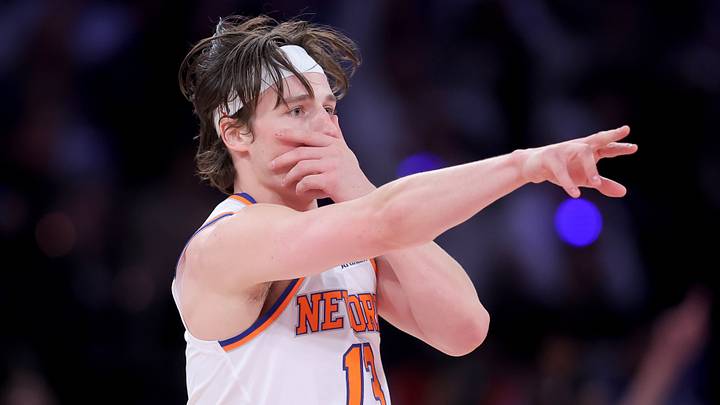
If Tyler Kolek and Mohamed Diawara want to be rotation regulars for the New York Knicks, they can no longer solely count on Mike Brown finding them reps during blowouts or off-nights for more prominent players. The NBA’s new lottery system has thinned out every team’s margin for error, including the reigning champs’, making it that much harder to juggle player development and title contention.
We needn’t rehash the full details of the league’s 3-2-1 system. For the Knicks’ purposes, all we need to know is that expanding the lottery to 16 teams while further flattening the odds heavily disincentivizes tanking. And with more teams trying to win, the night-to-night competition will be tougher to navigate as a result.
The impact of this new system is already evident across the Association. Especially in the Eastern Conference.
The Washington Wizards probably wouldn't trade for Trae Young and Anthony Davis last season if lottery reform wasn’t on the horizon. The Chicago Bulls are starting over under lead executive Bryson Graham, but haven’t torn down the roster. Even though they traded LaMelo Ball, the Charlotte Hornets have not pivoted into win-later mode.
This is all in addition to other Eastern Conference powers loading up to chase the Knicks. The Philadelphia 76ers, Cleveland Cavaliers, Miami Heat, and Toronto Raptors all made giant splashes this summer. Oh, and let’s not forget that as the defending champ, New York was always going to have a target on its back.
Add it all up, and you get no rest for the (potentially) weary—as well as a higher bar for Kolek and Diawara to clear.
Kolek and Diawara always faced an uphill battle to minutes
Even if the Knicks could meticulously monitor minutes and sprinkle in rest nights for their core players, Kolek and Diawara wouldn’t be ticketed for prominent roles. Ian Begley of SNY confirmed as much in his latest mailbag, noting that “it’s hard to see any of the young non-rotation players making consistent, significant contributions this season.”
This is especially true in Kolek’s case.
The Knicks are teeming with guards off the bench. Deuce McBride, Jose Alvarado, and Landry Shamet are all ahead of Kolek in the pecking order. If last postseason is any indication, Jordan Clarkson might be, too.
Diawara has a cleaner path to playing time given the roster makeup. He is the only properly sized and playable wing outside the starting lineup, so he’s always one rest night or injury away from seeing the hardwood.
On top of that, though, New York’s apparent willingness to enter the season with just two centers on the roster hints at a desire to field smaller secondary units. Diawara’s 6’9” frame and 7’4” wingspan become more important if the Knicks don’t immediately add another big.
Yet, any court time at all for him or Kolek rests on the assumption New York has the runway to stomach their mistakes. It might not.
Easier victories will be innately harder to come by with every team trying to win—or at least not actively trying to lose. The reality check should hit particularly hard during the final quarter of the schedule.
Games against rebuilding squads like the Brooklyn Nets, Milwaukee Bucks, and Bulls after the trade deadline can no longer be Sharpie’d in as layups. And with competition tougher overall, the Knicks may not be able to take their foot off the gas in the second half of the season. Too much will be at stake with playoff seeding.
The Knicks’ youngsters may not play if they can’t drive winning
For Kolek and Diawara to be more than break-in-case-of-emergency options, they’ll have to prove they’re ready to contribute towards a winning product. That means doing different things for each of them.
In Kolek’s case, he has to hone his pull-up jumper and overall scoring aggression, while limiting his live-ball turnovers. For Diawara, he’ll have to hit threes like he did the first half of last season, and add enough strength to guard further up the positional spectrum.
Without checking these boxes, neither player can routinely expect to see the light of day. And that’s not because the Knicks don’t believe in them. They have a clear stake in their futures.
Belief’s not enough on its own anymore, though. Not under the current lottery format in which even elite teams like the Knicks may struggle to rattle off wins while operating at anything less than the peak of their powers.
 Add us as a preferred source on Google