

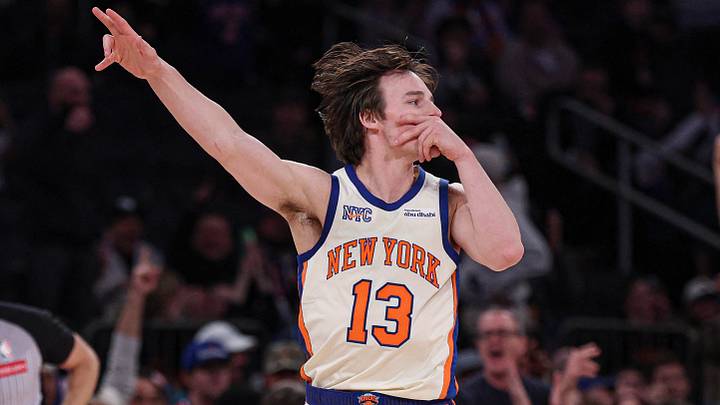
Cracking the New York Knicks’ backcourt rotation is no easy feat when looking at its primary members. Entering Year 3, however, Tyler Kolek has the power to not only enter it, but entirely reshape it—provided he develops a pull-up jumper.
This skill continues to elude New York’s floor general, albeit not in a hopeless way. Kolek actually drilled 38.1 percent of his pull-up threes last season. The problem? He attempted just two of them per 36 minutes.
That volume won’t prevent defenses from going under him on screens. He needs to ratchet up the threat level. This isn’t just a reference to his aggression from beyond the rainbow, either. He needs to be more of a self-starter when inside the arc, too.
Kolek banged in just 36.6 percent (15-of-41) of his pull-up twos as a sophomore. His rookie season was even worse on lower volume. He shot 20 percent (2-of-10) on off-the-dribble two-point jumpers.
Even adding some type of floater would go a long way. Kolek connected on just 42.8 percent of floating jumpers last year (18-of-42), and went 3-of-12 (25 percent) on these same looks as a rookie.
The Knicks are giving Tyler Kolek the motivation to improve
Turning these shortcomings into a strength isn’t a given, but it helps that Kolek has flashed real outside touch on other looks. Through his first two seasons, he’s shooting over 40 percent (42-of-104) on spot-up three-pointers. That lays the groundwork for doing more work from the perimeter.
Droves of clips that show Kolek putting in serious offseason work also lay a nice foundation. Summertime hype videos must be taken with a metric ton of salt, but this doesn’t appear to be someone content with riding the coattails of last year’s championship.
If anything, the Knicks’ offseason forces him to operate with the dials all turned to 11. They didn’t get rid of anyone from last year’s backcourt rotation. The starting lineup is another year older, but exactly the same. Jose Alvarado, Landry Shamet, Deuce McBride, and Jordan Clarkson are all back in the fold as well.
Important still, Alvarado wasn’t on the roster to begin last season. Or when Kolek was staking his claim to primary-reserve minutes. That technically puts an extra body in front of him. The pressure to improve only mushrooms if rookie sharpshooter Tyler Nickel is ready for minutes (and actually on the team).
Never underestimate the power of internal competition. It is what gave Kolek a shot at burn last season. It is also what led the Knicks to unleashing Landry Shamet. The current depth chart might just resonate—and therefore motivate—Kolek in a way it hasn’t before.
So much changes for the Knicks if Kolek can hit pull-up jumpers
Imagine that Kolek is shooting a league-average clip on pull-up threes and floaters. New York will have no choice other than to play him.
Forget about trying to figure out whose minutes he’ll infringe upon. Everyone coming off the bench will be at risk of retreating behind him. Kolek is already this team’s best passer, and a scrappy defender. We’ve also established that he can hit threes off the catch, which technically allows him to cede ball-handling possessions to others.
Pepper in some self-created jumpers on top of all that, and you’ve got a starting-caliber floor general coming off the bench. The implications of that would be far-reaching.
Kolek would surely usurp Alvarado and Clarkson in the rotation. Shamet’s size likely protects him against lost minutes, but the same could be said for McBride. Though he wouldn’t find himself buried on the bench, he’d be infinitely more tradeable ahead of free agency.
On the heels of a title and minimal roster turnover, it’s easy to view the Knicks as a contender absent any non-injury curveballs. That all changes if Kolek is able to moderately paper over the biggest hole in his game—not just for him, but for many of those around him, too.
 Add us as a preferred source on Google