

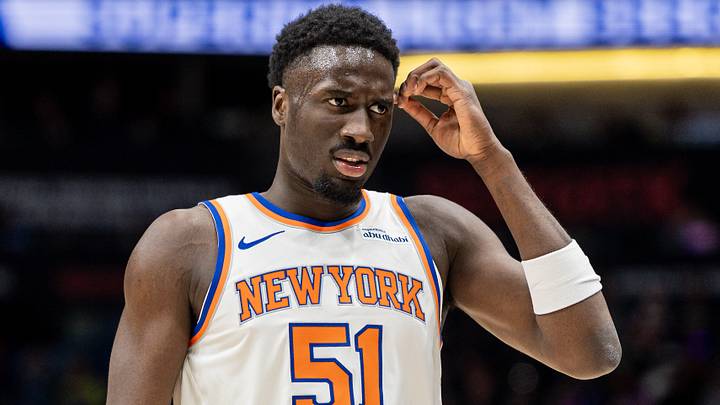
While everyone waits to see how the New York Knicks will fill their 14th roster spot prior to opening night, they are inclined to focus on what it could mean for the team’s center rotation, its eventual two-way contracts, and even the chances of a Deuce McBride trade. Regardless of who completes the 14-man depth chart, though, the Knicks have made it clear that they’re counting on Mohamed Diawara to plug multiple holes as a sophomore.
Big-picture expectations for the 21-year-old have skyrocketed after his standout rookie campaign. Enthusiasm isn’t being tempered by a summer-league stint to forget, either.
Diawara proved worthy of spot rotation minutes on the eventual champion during his first year. The Knicks then locked him down, before another team could steal him. Their investment in his development isn’t just implied; it’s a matter-of-fact.
Yet, when you take stock of their offseason moves to date and the transactions left to come, it leads you to a somewhat-startling realization: Whether by design or as an unintended consequence, they have more riding on Diawara’s development than anyone has predicted.
New York’s roster construction has increased the importance of Diawara
Any “Diawara is more important than we realize” missive must begin with the reserve-wing rotation. Or rather, the lack of it.
Aside from Diawara, Pacome Dadiet is the only properly sized wing coming off the bench. This is akin to saying that Diawara is the sole properly sized wing coming off the bench. Dadiet has shown very little as a pro, and didn’t do himself any favors this summer. Landry Shamet comes closest to an alternative, but at a slight 6’5”, he’s more of a guard.
Having OG Anunoby, Mikal Bridges, and Josh Hart arms the Knick with enviable cover on the perimeter. They can stagger minutes to make sure two of them are on the court at nearly all times.
Still, injuries happen. Coming off two ultra-deep playoff runs, rest nights will probably happen. More than that, the center rotation has increased the Knicks’ dependence on their wings.
Karl-Anthony Towns and Andre Drummond are the only 5s on the roster as of now. They cannot take the floor at the same time. Dual-big lineups weren’t a high-volume staple last season, but we saw KAT and Mitchell Robinson play together in measured doses. Even the idea of dual-big combinations afforded New York flexibility on the wings, making it so Mike Brown could get by using one of OG, Hart, or Bridges if need be.
That option is now off the table. Given the current big-man landscape, the Knicks are unlikely to revive it should they, as expected, use their 14th roster slot on a third big.
Drummond’s arrival leaves the Knicks even more reliant on Diawara
On top of all that, going from Robinson to Drummond is a significant defensive downgrade. Drummond can’t hang on the perimeter as well, and has graded out as an above-average rim protector just once in the past 11 years.
The Knicks are going to need forwards to help insulate him—to not just guard the perimeter but clean up messes behind him. Anunoby fits the bill, and then some. But New York can’t tether him to Drummond’s minutes without limiting his volume alongside Towns.
Hart contests more shots at the basket than your typical wing, but he’s still just 6’5”. Bridges has the length, but not the raw physicality required to do that much interior lifting.
So if it isn’t going to be Anunoby, the Knicks desperately need it to be Diawara. He’ll have to get stronger to check enough safety-net boxes, but that’s typically a focus for second-year players. And even if he’s not more physical, he’s 6’9” with a 7’4” wingspan. The size and length dictate he be the answer.
New York could always winnow down its dependence on Diawara by adding another wing, or with pristine availability from the Anunoby-Bridges-Hart collective. Realistically, however, surviving the regular-season gauntlet will require Diawara to be more than a feel-good story.
Failing a surprise move for another combo wing or more versatile big man, he may need to be someone the Knicks can count on for at least 1,200 minutes of action—roughly double the court time he received last season, if not even more than that.
 Add us as a preferred source on Google