

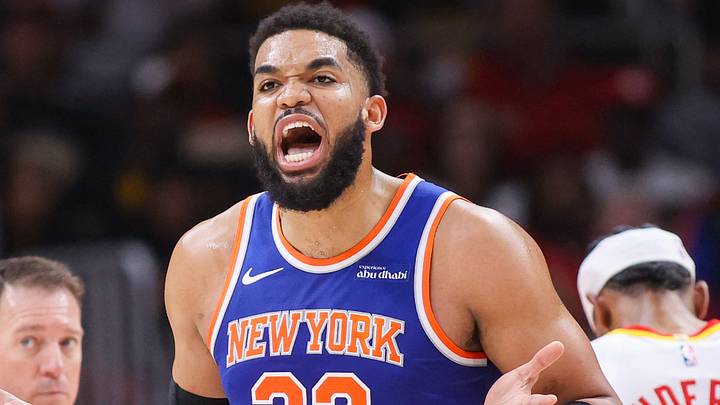
Karl-Anthony Towns is going to sign an extension with the New York Knicks. Relative to how the front office has treated critical players one year out from free agency, this isn’t speculation so much as a fact. But while people get bogged down by how much money he might get, the Knicks also need to decide whether his extension will kick in after this coming season, or in 2028-29.
Towns currently has a $61 million player option for 2027-28. Veteran extensions cannot run longer than five total seasons, including the current years remaining on the contract. Between 2026-27 and the 2027-28 player option, Towns technically has two seasons left on his deal. If he wants to sign the four-year extension for which he’s eligible, he’ll have to tear up that player option.
In the Knicks’ perfect world, Towns would ditch the option, and sign a discounted four-year pact that gives them more maneuverability beneath the second apron next summer.
Then again, maybe not.
Starting Towns’ new deal in 2028-29 could help the Knicks with Jalen Brunson
One alternative extension scenario would see Towns keep his $61 million salary for 2027-28, and then sign a three-year deal. The benefits of traveling this path are, admittedly, not immediately clear for the Knicks.
Keeping Towns at $61 million in 2027-28 has all sorts of trickle-down effects. For starters, it basically guarantees that Deuce McBride will leave in free agency or be traded this season. It would also complicate contract talks with Josh Hart, regardless of whether New York wants to extend him now or wait until next summer.
That’s just the beginning. This doesn’t even get into how limited the Knicks would be when attempting to fill out the rest of their roster.
Still, even if Towns takes an immediate pay cut, everything we just mentioned will remain a dilemma, albeit on a smaller scale. In the event New York has him pick up his player option, it allows the front office to get out in front of Jalen Brunson’s next contract.
If the captain signs an extension next summer, his salary will jump to $63.9 million in 2028-29. That is nearly a $24 million increase from the $40.5 million he’ll earn in 2027-28, and bound to cause a collateral-damage reckoning.
Navigating that price-point surge gets a lot easier if Towns is on the books for waaaay less than expected in 2028-29.
Here’s what an alternative KAT extension could look like
Let’s say Towns is willing to accept a total of $180 million over the next four years. The Knicks could rip up his $61 million player option, and lower his salary in 2027-28.
If they offer standard raises, he’d drop to around $40.2 million. If they offer a flat rate, he’d dip to $45 million. (They could also start him higher than $45 million, but lower than $61 million, and have his future salaries decline.)
Going this route increases immediate and long-term flexibility. With Brunson’s salary about to explode, though, the Knicks might prefer to emphasize the latter.
To that end, New York could get Towns to $180 million over four years by having him pick up his $61 million player option, and then sign him to a three-year, $119 million extension. Assuming standard raises and escalation, this would put Towns on the books for $36.4 million in 2028-29—nearly $7 million less than would be the case if he declined his option and signed a four-year, $180 million deal.
This is a pretty big difference when you consider the fine financial lines New York continues to toe. Having another $7 million in malleability could enable the Knicks to keep someone like Landry Shamet versus offloading him to sneak beneath the second apron. It could even make it more plausible for the team to keep the starting five intact once Brunson’s next deal takes effect.
Whether that’s enough of a benefit for the Knicks and Towns to discuss this framework remains to be seen. But the overall point stands. Signing KAT to an extension isn’t just about the Knicks determining how much he’s worth. It’s also about deciding how to spread out the money they’re prepared to give him.
 Add us as a preferred source on Google