

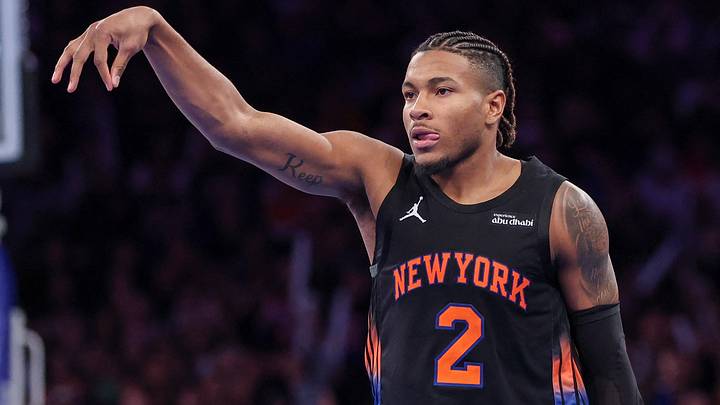
Just about everyone in the New York Knicks’ orbit believes the team is headed toward a divorce from Deuce McBride. The sentiment is straightforward: McBride is entering the final year of his contract, and will be too expensive beyond next season to keep around for an organization that, so far, seems unwilling to enter the second apron.
Except, when you look at the market for small guards who don’t run the offense, you come to find that Deuce’s next deal isn’t the primary problem at all.
Instead, the force driving him towards the exit is actually the Knicks’ depth chart.
The Knicks can’t give Deuce McBride a bigger role than he has now
Going on 26 years old this September, McBride is just entering his prime. Upgrading his role is bound to rank near the top of his bucket list—especially now that he’s already an NBA champion.
Never, at any point in his career, has McBride been an every-night starter. Equally important, he has never registered as an every-matchup closer. This past season was also the first time he averaged more than 25 minutes per game.
New York isn’t currently built to accommodate anything more for its three-and-D gem.
Regularly starting and closing games is out of the question. The Knicks aren’t moving Jalen Brunson, Mikal Bridges, OG Anunoby, or Josh Hart to the bench in favor of him. Starting McBride over the latter was a legitimate debate once upon a time. It no longer registers on the radar after New York ended its championship drought.
Guaranteeing Deuce the sixth man’s spot no longer looms as a realistic option, either. Between Landry Shamet’s shooting and additional size and Jose Alvarado’s ball-handling and passing, the Knicks are more likely to have a fluid first-man-off-the-pine rotation. That’s before even considering the return of Jordan Clarkson, or the potential development of Tyler Kolek.
New York’s crowded backcourt is more of an issue than Deuce’s future contract
This glut of guards makes it difficult to envision McBride carving out a larger role than he had last season. Maybe if he waits long enough for Hart, Bridges, Alvarado, or Shamet to age or price themselves out of town, he’d have a crack at more prominent minutes. But that opportunity isn’t coming anytime soon.
Not to say that the money doesn’t matter. New York is toeing fine financial lines, and McBride is due for a raise from the $4 million he’s making now. At the same time, the current free-agent landscape makes it unlikely that he more than doubles his salary. History suggests, if not guarantees, McBride’s next deal will start at under $10 million—a more-than-reasonable number.
Even if the money is equal between the Knicks and other suitors, the path to more responsibility will almost definitely be clearer elsewhere. That alone is enough for McBride to skirt any interest New York might have in extending him, and wait for free agency to make his decision.
This, in turn, makes a trade inevitable. With the exception of Mitchell Robinson, the Knicks’ front office has opted to deal important rotation players who aren’t on the same page as them in extension talks.
In this case, however, the eventual decision to move him could be less about the price point, and more about the opportunity McBride wants or deserves, but New York can’t offer.
 Add us as a preferred source on Google