

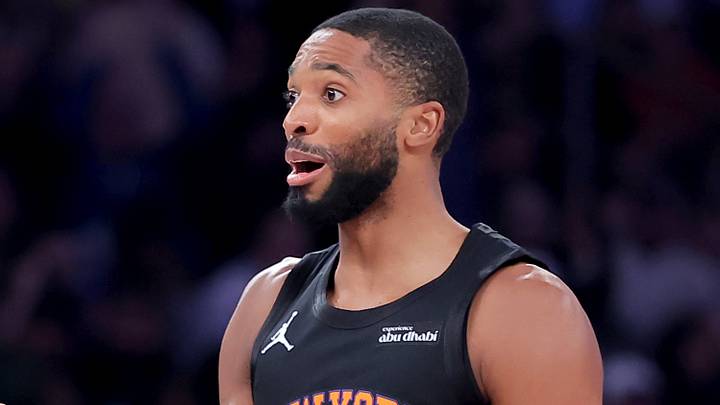
Mikal Bridges’ putrid start to the season already has people wondering whether the New York Knicks’ would both be better off without him. On the heels of yet another fourth-quarter benching, and with every other starter soon in need of a new deal, the idea is bound to pick up steam.
In some ways, it already has.
Stefan Bondy of the New York Post wrote about how flipping Bridges for an expiring contract would allow the Knick to keep everyone else. To all the bad-faith aggregators out there, Bondy was neither advocating for the move nor reporting that it might happen. His analysis was more about why they could consider it; not why they should.
Still, the onrush of calls to trade Bridges are coming, if they haven’t already started. The premise behind all of them will be flawed. Trading him is not the answer to the Knicks’ (self-imposed) financial crunch. And it certainly isn’t going to make them better.
Trading Bridges only mildly helps the Knicks’ second-apron issues
Removing Bridges’ $36.1 million salary from the 2027-28 ledger does make the Knicks a whole lot cheaper. They could re-sign or extend Karl-Anthony Towns (player option) and Josh Hart (team option), likely keep Deuce McBride, and even have access to the mini mid-level exception.
Here’s the thing: The Knicks could technically be able to do all of that without getting rid of Bridges. They have already drawn a line in the sand on what they’ll pay KAT. Recent market trends suggest they will wind up winning the negotiation. If and when they do, they’ll be in a position to also keep Hart, and at the very least, re-sign McBride or use the mini MLE.
Sure, dealing Bridges would make it easier to give Towns more than $45 million to $50 million per year. But jettisoning a starter and one of your most important defenders just to pay a center in his 30s more money than you’re comfortable with makes little sense.
This discussion would carry more weight if Bridges guaranteed the Knicks can sidestep second-apron concerns in 2028-29, the year that new extensions for Jalen Brunson and OG Anunoby would take effect. It doesn’t.
Let’s assume that Brunson is on a max deal by that point starting at $63.9 million, and that Anunoby is earning right around his player option ($48.9 million). Then, let’s also assume Towns is on the books for $50 million, and Hart is making around $20 million. That leaves the Knicks with $182.8 million committed to four players. The second apron in 2028-29 projects to be $248.3 million, so the team would have $65.5 million of room beneath it…while still needing to fill 10 roster spots.
These projections change if Landry Shamet ($6.2 million), Jose Alvarado ($5.2 million), and Mohamed Diawara ($2.9 million) are still around. The Knicks in that scenario would have $51.2 million in breathing room under the second apron, with another seven roster spots to fill.
Filling out a title-contender’s rotation at an average of $7.3 million per roster spot (under 4 percent of the salary cap) is a tall order. Without Bridges on the roster, another core player would almost certainly have to go.
A Mikal Bridges trade makes less sense than ever
Shopping Bridges is more defensible if the Knicks believe moving him helps the immediate product. Despite all of his offensive warts, it remains difficult to make the argument. You would have to believe this current rut is his new normal. His own track record suggests it won’t be.
Even if it is, other teams have eyes. They aren’t going to pony up a small ransom in draft picks and rotation players for someone New York is unloading at the nadir of his value.
Entertaining packages at all also ignores how important he is to the defense. His 10 highest-volume assignments this season, in order, include Tyrese Maxey, Cade Cunningham, Jalen Suggs, LeBron James, Derrick White, Norman Powell, Franz Wagner, Michael Porter Jr.. Anthony Black, and VJ Edgecombe. Shamet and McBride cannot handle that range of covers.
Major changes are coming to the Knicks no later than 2028-29 regardless of what happens this season. Accelerating that timeline with a Bridges trade only makes sense if it improves their title odds this year or next. It doesn’t, so they shouldn’t.
Knowing how this front office operates, they’re smart enough to realize it.
 Add us as a preferred source on Google