

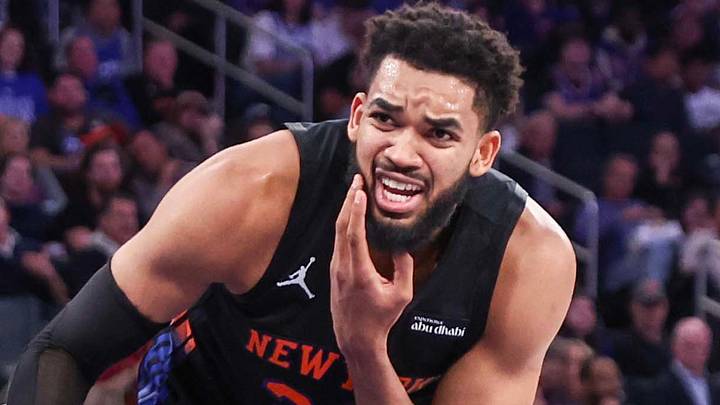
Declining Pacome Dadiet’s team option gives the New York Knicks another $5.4 million in breathing room underneath next year’s second apron. That is extra flexibility they can technically allocate to Karl-Anthony Towns’ next deal.
Except, they probably won’t.
New York’s negotiations with Towns have never been just about affording him while remaining under James Dolan’s self-imposed second-apron ban. It’s about paying him and being able to keep everyone else—including, potentially, Deuce McBride.
The Knicks have already hinted at as much two times over. First, their reported offer of $45 million to $50 million per year is specific enough to read the tea leaves. Then, they let a deadline pass that would force him to decline his player option as part of any in-season deal.
Getting Dadiet’s money off next year’s books, free and clear, is the next part of that plan.
The Knicks’ Karl-Anthony Towns offer is no accident
Let’s use the $50 million-per-year benchmark as a placeholder for Towns. With Dadiet off the books, this would leave the Knicks with $23.8 million in second-apron room while having nine players on the ledger. That includes Josh Hart’s $22.4 million team option, but not a new deal for McBride. Yet.
Before going any further down the Deuce-and-KAT rabbit hole, we need to fill out the bulk of the roster. The Knicks must get to 14 players. In the spirit of being ultra-aggressive, we’ll assume they want to use next summer’s mini mid-level exception, which adds a projected $6.5 million to the tally.
After that, New York currently carries three veteran minimum contracts in Jordan Clarkson, Andre Drummond, and James Wiseman. While the names on these spots might change, let’s also presume they want three experienced players on the roster again.
A trio of vet minimums adds another $7.8 million to the table. Between that and the $6.5 million mini MLE, the Knicks would have 13 players and roughly $9.5 million in breathing room below the second apron.
Most agree that alone won’t be enough to keep McBride. But he also isn’t going to cost as much as many believe. Though Payton Pritchard’s recent two-year, $44.1 million extension gets thrown around as a comp, he can initiate more of the offense than McBride. Undersized three-and-D specialists tend to get less than eight figures annually.
New York’s master plan is coming into focus
None of this ensures the Knick can re-sign Deuce if Towns accepts their extension offer. In all likelihood, McBride will cost more than $10 million per year.
Still, with Towns on the docket for a flat $50 million-per-year and Dadiet off it, different avenues begin to open up. Maybe Josh Hart signs a new deal that pays him less than $22 million a season, creating even more flexibility. Perhaps the Knicks decide they’d rather have McBride over using the mini MLE. They could even still choose to trade him by the February 11 deadline.
The overarching takeaway from the Dadiet decision and the front office refusing to come up from their offer to KAT nevertheless remains the same. The Knicks aren’t playing checkers; they’re playing 8-D chess with one arm tied behind their back—attempting to keep Towns without nuking their capacity to re-sign or add others.
 Add us as a preferred source on Google