

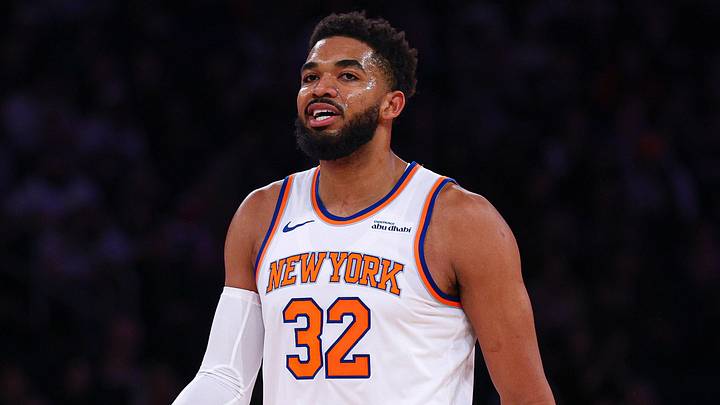
Karl-Anthony Towns can no longer sign an extension with the New York Knicks while also picking up his $61 million player option for next season. The deadline to do so passed at 11:59 p.m. EST on October 19.
By letting this cutoff come and go, New York has made it clear, once and for all, that it wants KAT to take an immediate pay cut in 2027-28.
This wasn’t necessarily a given. With Jalen Brunson’s next contract expected to take effect in 2028-29, the Knicks could prefer to keep Towns at a higher number in 2027-28, then have his salary decline year-over-year once JB gets a lot more expensive.
That scenario is now off the table. Though Towns can still reach a new agreement with the Knicks in-season, he must first decline the option to make it happen. And frankly, the fact this deadline didn’t faze New York says a lot about how much leverage it holds.
Skipping this Karl-Anthony Towns deadline is pretty revealing
Recent reporting had the Knicks offering KAT somewhere between $45 million and $50 million per year in an extension. That average annual value is far lower than his $61 million player option, or what his max salary would be if he opted out ($61.6 million).
Based on that alone, New York isn’t just looking for Towns to lower his cap hit in 2028-29, when Brunson’s salary could skyrocket by more than $20 million. It wants him earning less than $61 million right away.
This could be good news for someone like Deuce McBride and Josh Hart (team option). The cheaper Towns is after this season, the more flexibility the Knicks will have to pay Hart and try to keep McBride.
Granted, this could backfire on New York, too. Towns might ball out this season, at which point the Knicks may start to believe he’ll have max offers from other teams waiting for him next summer. A contract from another squad projects to top out at four years and $265 million. If New York buys that as a legit threat, it will have to come up substantially on its own offer to keep him off the open market.
The Knicks are betting that doesn’t happen. From a business perspective, it’s a smart wager. Only one free agent since 2022 has walked in free agency and received more than $40 million per year. It was Paul George’s contract with the Philadelphia 76ers, and we all know how that turned out.
This deadline change doesn’t change too much for the Knicks
Knowing what the Knicks already had on the table, the October 19 deadline coming and going probably doesn’t mean much. They clearly wanted Towns to rip up his player option all along.
Plus, if they want Towns’ salary to scale down, they could just sign him to an in-season extension that starts at his max ($61.6 million), and then declines by 8 percent year-over-year. Or they could wait until after the season, have him opt him to $61 million, and then extend him.
Of course, if they down either of those paths, a four-year extension comes out to $215 million or more—a much higher number than they’re willing to pay now.
In the end, that’s the biggest takeaway from all of this. The Knicks aren’t ruling out a KAT extension by letting this preseason deadline pass. They’re making it clear it has to happen on their terms—with a cheaper salary in 2027-28 than he’s currently scheduled to have.
 Add us as a preferred source on Google