

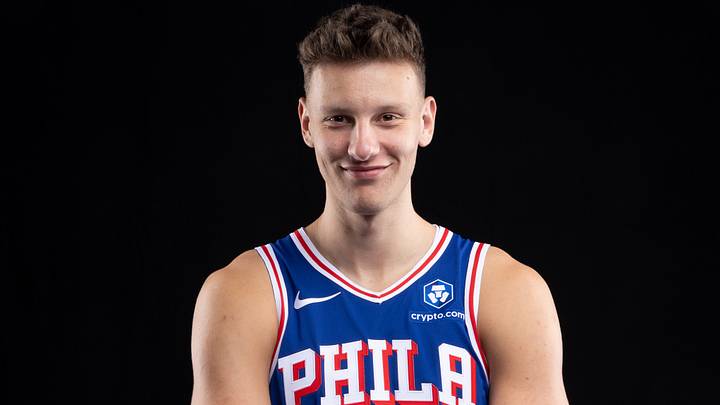
As the New York Knicks continue filling out their training camp roster, they will invariably need to decide between adding vets with proven track records or mystery-box youngsters who amount to stabs in the dark. Their imminent title defense will nudge them toward options with more experience. They need to quell that urge, and go after more players like the recently signed Igor Milicic Jr. instead: youngsters with untapped upside, who could potentially fill roles on the cheap beyond this coming season.
Looking beyond the attempt to repeat is dangerous. The Knicks have another chance to win a title now. Compromising that opportunity in favor of wild guesses with little to no chance of moving the 2026-27 needle can come across as downright reckless.
It’s not.
If anything, it’s more reckless of New York to let itself become a captive of the moment.
The Knicks shouldn’t overthink their remaining roster spots
Here’s the dirty, not-so-little truth about the Knicks filling their 14th and, eventually, 15th roster spots: Nobody they add, however experienced, is especially likely to matter.
The meat and potatoes of next year’s rotation is set. So much so that we already have confirmation Mohamed Diawara and Tyler Kolek will be hard-pressed to get minutes.
Someone like Bruce Brown Jr., Drew Eubanks, or John Konchar is not going to usurp any of the players Mike Brown already has penciled into his rotation. If they do, something terrible has happened. And while planning for worst-case scenarios is essential, none of the vets left on the open market are going to help the Knicks navigate an absence from any one of their five starters.
Taking fliers on less-proven players who aren’t supposed to be in their primes, let alone past them, makes more sense. If one of them pans out, the Knicks will have someone on the younger and cheaper side who’s familiar with their system, and can sponge up minutes after this season as the team gets more expensive.
Youthful fliers are more likely to become the next Landry Shamet
Skeptics of this approach will note that Landry Shamet was New York’s final addition before the start of last season, and he absolutely mattered. That’s a great point. It also happens to support the one we’re making here.
Options on the younger side are more likely to exceed expectations than well-traveled vets. Shamet was the mother of all exceptions. Injuries derailed what was once a rock-solid career arc. He arrived in New York, and pieced a preexisting trajectory back together.
A 30-year-old Brown is suddenly going to break out. Especially with four to five guards ahead of him in the rotation. Identical logic applies to 29-year-old Eubanks, and 30-year-old Konchar.
Someone like a 22-year-old Cam Whitmore has a better chance of replicating Shamet’s ascent. He is flawed enough and has enough health concerns after last season’s blood clot that he’s available. But he showed not too long ago, mostly as a rookie in 2023-24, that he can be an active contributor in the rotation.
Ochai Agbaji is another name that falls into this familiar-but-not-proven bucket. Ditto for Amir Coffey, though he’s now 29. David Roddy, 25, could fit the bill.
At the same time, the Knicks shouldn’t be afraid to venture into even murkier waters, much like they are doing with Milicic. Players like him, with virtually no NBA experience, are not just easier to find. They are also more likely to accept two-way contracts if they don’t make the roster. Wouldn’t you know it, the Knicks have all three of their two-way slots available.
These microdecisions feel inconsequential now, but investing upside or what’s unexplored can have a bigger impact later. As much as the Knicks must remain laser focused on the here and now, the second apron isn’t going anywhere. If they want their window to extend beyond the next couple of seasons, they need to stockpile more younger cost-controlled fliers than just Kolek, Diawara, and the still-unsigned Tyler Nickel.
 Add us as a preferred source on Google