

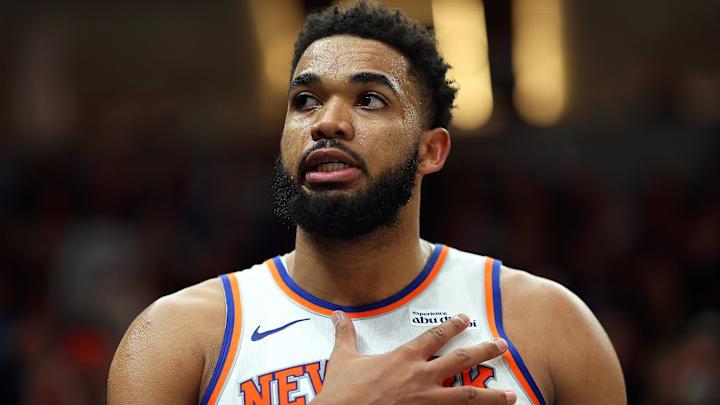
Trae Young’s value has plummeted if the latest trade rumors are true. Unless they act this summer, the New York Knicks could be facing a similarly tumultuous situation with Karl-Anthony Towns.
According to Marc Stein of The Stein Line, the Washington Wizards have emerged as a serious suitor for Young, who they’d reportedly acquire using a package built around CJ McCollum’s expiring salary. The real kicker, as Stein also notes, is “it remains to be seen whether the Hawks would also have to send the Wizards draft capital to convince them to absorb Young's contract.”
This is a wild notion when you really think about it. For all his flaws, Young is a four-time All-Star, with career averages of nearly 25 points and 10 assists per game. The idea that he will net nothing more than salary ballast, let alone require Atlanta to compensate Washington to take on the final year of his deal (2026-27 player option), is bonkers.
Yet, at the same time, it speaks to the NBA’s new trade and team-building climates. And if the Knicks aren’t careful, they could run into a similar issue with Towns.
Karl-Anthony Towns’ contract is not necessarily an asset
Let us start off by noting that Towns is a clear level above Young. He has five All-Star appearances under his belt, as well as three All-NBA selections. While both are deeply flawed players, Towns is more valuable by virtue of being a positional anomaly. The shooting and driving he offers remains atypical for a seven-footer.
Still, with two years and $118.1 million left on his deal, he is not what you’d call a bargain. If you’re paying someone around 35 percent of the salary cap, you want them, at the very least, to be a reliable No. 2 option. Towns has struggled to prove he’s even that. His highs are high, but the lows are even more extreme.
Then, of course, there are the clear, ever-present defensive limitations. Despite turning up the execution dials over the past two postseasons (one of which came in Minnesota), he remains a weak link at whom opponents love to poke and prod. It is a real issue when your $57-plus-million-per-year center may not actually be able to play center in enough matchups to maximize your playoff ceiling.
If you think this underestimates Towns’ value, ask yourself this: Which team, right now, would give the Knicks multiple first-round picks to land him? If you have a definitive answer, I’d love to hear it. Realistically, though, Towns at his current price point is not dissimilar to Julius Randle. He was more valuable to the Knicks than anyone else, and the lack of outside trade interest in him proved as much.
Fortunately, the Knicks can avoid a Trae Young-type dilemma
If New York does nothing with Towns this summer, it could be speeding toward an awkward dilemma. The big man will technically be one year out from free agency, but his $61 million player option for 2027-28 is large enough that we must assume he’ll pick it up if he’s not extended.
So, the Knicks should probably extend him…under a specific set of circumstances.
Towns will be eligible to sign a three-year, $215.5 million extension this summer, assuming he exercises his 2027-28 player option. New York should not commit that much to him. Instead, it should try getting him to decline that player option, and lower his annual cap hit as part of a new deal.
Here is how something like this would work: Towns could decline the $61 million player option, and sign a, say, three-year, $135 million deal. This would lower his average annual value to $45 million—around 27 percent of the salary cap. That beats the 35 percent he’d cost at the max.
Towns may flinch at the idea of a pay cut. But let’s be real: Nobody is maxing him out in 2028, going into his age-33 season. This pathway allows him to lock in another $74 million of guaranteed money rather than chance the open market, at a time when teams are reluctant to spend big on anyone who’s not a top-10 player.
The dollar figures here are not a hard-and-fast line. Perhaps Towns will retain value if he’s slightly more expensive. Or maybe the Knicks can get him for less. Regardless, they need to see what Towns is thinking about extending this summer.
Because if he’s not willing to travel down this cheaper-per-year path, New York may need to cut its losses rather than possibly see his value deteriorate, much like Young’s, as he nears the end of his current deal.
 Add us as a preferred source on Google