

Despite being the closest thing to a consensus pick to win the Eastern Conference, the New York Knicks just received a mammoth reality check: Other NBA teams aren’t worried about them.
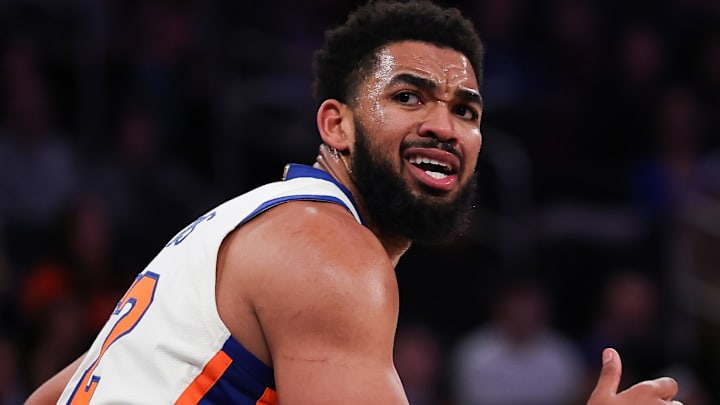
And Karl-Anthony Towns is among the primary reasons why.
Really, though, it seems to be the defense at large.
Speaking on the latest episode of The Zach Lowe Show, Zach Lowe relayed some unsettling opinions from around the league. “I don’t hear a lot of people from other Eastern Conference teams express a lot of fear of the Knicks,” he explains, at around the 56:16 mark. “Their offense is unassailably really good. It’s their defense, and the lack of just general faith in KAT to make smart decisions in high-leverage moments.”
Lowe goes on to note that he thinks the criticism leans too heavily on Towns’ own flaws. He has shown a higher competency level over his past two postseason runs, including last year’s lead-up to the Eastern Conference Finals to the Knicks.
Still, the broader strokes of this criticism hit hard—too accurately, even. The Knicks’ defense is a problem. And while it might be a solvable one, New York is currently playing like a squad intent on proving its critics…right.
The Knicks defense has reached a breaking point
Ever since pummeling the Toronto Raptors in the NBA Cup quarterfinals, the Knicks rank in the bottom five of points allowed per possession. Their biggest issues are mostly the same as ever, and manifesting on a larger scale.
New York’s point-of-attack defense is shaky after Deuce McBride. Three-point closeouts are inconsistent. General perimeter rotations are lackluster. Everything, at all times, seems dependent on OG Anunoby reaching superhuman levels of disruption and cover for others. Opposing teams will deviate from core offensive tenets just to poke and prod at not only KAT, but Jalen Brunson.
Watch the Knicks for long enough, and you can sense the lack of second-guessing they instill into other players. As Lowe also notes, their most recent loss to the San Antonio Spurs catalyzed the external skepticism. Even without Victor Wembanyama on the floor in the fourth quarter, they carved up New York, posting a 172.7 offensive, and winning the final frame by eight points. Those margins matter in a two-point game.
The Knicks do have somewhat-viable excuses for struggles outside that marquee matchup. Josh Hart and Mitchell Robinson have each missed at least three games during this stretch. McBride just recently returned to the fold. The rotation isn’t just heavy on experimentation amid a rotating cast. It has, until the past few games, featured plenty of emphasis on young-player development.
This does little to assuage concerns, in large part because the overarching worry is the same as it has ever been: New York is trying to see whether it can reliably field a competent defense while built around Towns and Brunson.
As hard as it is to admit, the answer so far this season is no. All five of the Knicks’ most-used lineups rate as below-average defensive units. Only one of them ranks higher than the 31st percentile. Combinations with both JB and KAT are in the 28th percentile of points allowed per possession, and getting burned at both the rim and from beyond the arc.
The latest stretch is particularly unnerving. Just three of the Knicks’ last 11 outings have come against top-10 offenses. Their defense places in the bottom five anyway. Even with Hart and Robinson missing time, this isn’t something anyone, anywhere, can just write off.
New York can’t ignore the rest of the NBA’s message
Tough stretches are part and parcel of an 82-game schedule. The Knicks are in a rut. They are not damned for eternity.
Certain issues will be cleaned up. New York isn’t a bottom-five defensive team, warts and all. Most critically, Towns alone is not the team’s biggest problem. It has issues up and down the depth chart, including on the offensive end.
If nothing else, though, this leaguewide sentiment should be treated as a reality check. The Knicks do not have the margin for error to disengage defensively, and contend for a title anyway.
Whether it’s an internal lineup shift or a trade for another top-eight rotation member, something material must change. Otherwise, New York will continue hovering in that area between good and great, still better than most, yet not nearly convincing enough to be viewed—and feared—like an inner-circle title threat.
 Add us as a preferred source on Google