

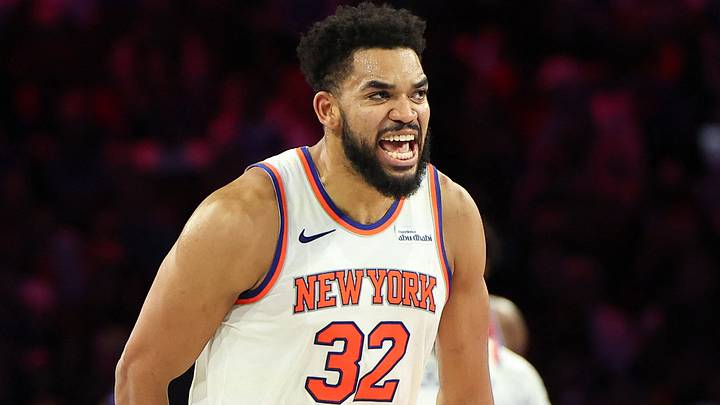
Karl-Anthony Towns established himself during last year’s playoffs as the NBA’s best offensive center not named Nikola Jokic. And though he’s living up to that bar to begin this season, he has another level to reach as both a passer, and perhaps a scorer.
All he has to do is drive the ball more often. Or at least as much as he did last year.
Because despite what’s happened in the past, Towns’ drives are no longer just a vehicle through which to score. They are a means to setting up the rest of his team.
Karl-Anthony Towns’ drives are down this season
The seven-footer averaged over 9.4 drives per 36 minutes during the 2025-26 campaign. He then hovered slightly below nine throughout the New York Knicks’ postseason run. This number has dipped all the way to seven drives per 36 minutes to start 2026-27.
That isn’t high enough. Towns is among the most unique drivers in basketball. He is fast for his size, and doesn’t shy from physicality. He has routinely ranked among the best scorers going downhill to boot.
This makes the dip in driving volume much harder to explain. Especially when you consider he’s not holding the ball less.
Towns is actually averaging more frontcourt touches and a noticeably higher time of possession per game while playing fewer minutes. He’s also throwing more passes each night, another byproduct of New York funneling a larger share of its offense through him. If not for his preference to try high-risk passes and the Knicks’ collective shooting slump, we’d likely be talking about him averaging more assists.
Even with this extra volume and peripheral caveats, neither New York nor Towns is tapping into his full playmaking potential. The standstill vision is great, but he’s improved as a live-dribble passer as well.
The Knicks’ offense badly needs more Karl-Anthony Towns drives
Throughout his time with the Timberwolves and the start of his Knicks tenure, Towns never passed all that much out of drives. His playmaking has always been at its most dangerous when operating from a standstill, and diming up cutters and shooters.
This changed last year. The shift began later in the season, but really took off in the playoffs. From Game 4 against the Atlanta Hawks through the end of the NBA Finals, Towns passed on over 39 percent of his drives. For context, he has never passed on more than 26.6 percent of his drives over an entire season.
Towns has continued his playoff trend into this year. He is passing on nearly 30 percent of his downhill attacks, and has thrown an assist on roughly one in every nine drives. The sample is small, but both marks would be career highs.
Getting KAT on the move has to be more of a focus with the Knicks’ offense currently stuck in the mud. The team is 20th in points scored per possession outside of garbage time. That won’t hold, but New York would boost its standing a lot faster if it exchanged the experimental touches being burned on OG Anunoby for more KAT touches.
Failing that, the Knicks have the power to send more ball screens on Towns’ current possessions. He also has the on-ball force and gait to simply get downhill more often.
Excluding foul trouble, what Towns has done this year is largely spectacular. He nevertheless has room to get better. And it starts with he and the Knicks sufficiently exploring all the ways he can generate offense for himself and for others.
 Add us as a preferred source on Google