

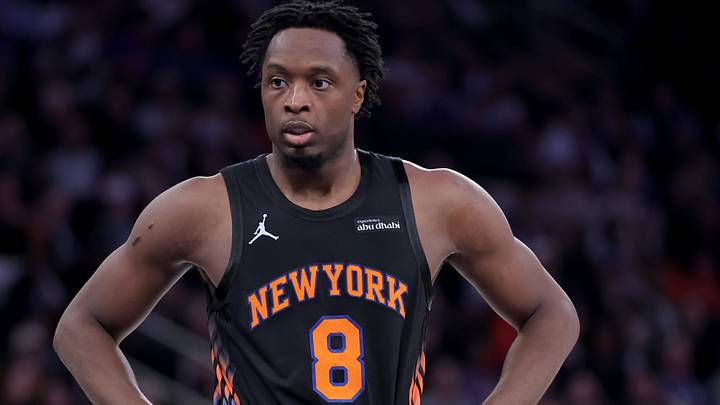
OG Anunoby has opened the 2026-27 regular season shouldering a more prominent role on the offensive end. And it’s already time for the New York Knicks to rein him back in.
The tweaks and expansions to his offensive usage cover a few different areas. Overall, though, the Knicks are putting the ball in his hands more often.
Anunoby’s frontcourt touches have increased by 20 percent from last season while averaging around the same number of minutes per game. His 12.9 drives per 36 minutes are a monstrous upswing from the 9.4 he posted in 2025-26.
This additional volume is supposed to help fuel an All-Star case that’s never quite peaked, and also make life easier on Jalen Brunson. Even with Karl-Anthony Towns’ standstill playmaking and driving, the Knicks need to have others who can work off the dribble, particularly against pressure.
They clearly hoped Anunoby could be among the outlets. He can’t.
OG Anunoby’s offensive struggles can no longer be ignored
Some good things have come out of OG’s extra on-ball reps. He is at least attempting to be a more willing facilitator. Over half of his drives are now ending in a pass. His revamped role also hasn’t resulted in an overkill of mid-range freelancing. Just 7 percent of his shots have come from the in-between, which is actually lower than his 15 percent share from last season.
Still, funneling so much of the offense to him has effectively nuked his efficiency. His effective field-goal percentage—combined measurement of two-point and three-point accuracy—sits under 47. That is the lowest mark of his career. The Knicks can count on him hitting more than 27.8 percent of his triples, but the driving efficiency isn’t guaranteed to improve.
Just 43.3 percent of his drives are ending in points. Among 48 players who have finished as many of these plays, this mark ranks 39th.
Though his turnovers haven’t been out of control, he doesn’t have the handle to counter or navigate collapsed defenses consistently enough when going downhill. And while he may be trying to pass more, the effort isn’t generating better looks for his teammates. Anunoby’s assist-to-usage ratio ranks in the 36th percentile, an indistinguishable uptick from last year’s 33rd percentile finish.
The Knicks can’t use the small sample as an excuse
All the usual small-sample caveats apply. Anunoby will make more shots. So will his teammates. But his offensive workload and performance is starting to permeate his defensive play. He hasn’t executed with the same regular dominance to which the Knicks are accustomed.
Once the plus-minus god, Anunoby now has the second-worst net rating swing on the team. The Knicks have so far fared better on both ends of the floor when he's off the court. The same cannot be said for any other starter than Mikal Bridges.
This isn’t cause for Mike Brown to stick Anunoby in the corner, and consign him to spot-up duty. His driving is valuable. But its utility is rooted in catch-and-go attacks. He isn’t someone for whom you should try setting ball screens, or asking to probe from a dead stop. His bag isn’t deep enough.
That’s not an indictment of him, either. Anunoby isn’t supposed to be a superstar creator. He might have fancied himself one in the past, but this is Year 10. It’s not happening.
Anunoby’s path to All-Stardom is the same as it ever was: take and make a ton of threes, attack closeouts and eat open spaces, and maybe ratchet up the offensive rebounding if New York’s transition defense can stand it.
Expecting him to do much more is unfair—both to him, and clearly, the team.
 Add us as a preferred source on Google