

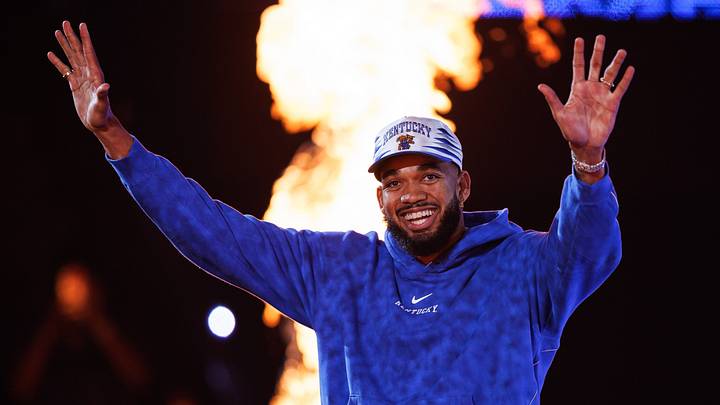
The New York Knicks are trying to solve a puzzle. Their refusal to surpass the second apron of the NBA's salary cap does not make them an outlier; 28 other teams are alongside them, underneath the threshold, as of Tuesday. It is, however, ultimately a self-imposed layer of complication to their efforts to keep who's left from their championship-winning core after Mitchell Robinson's departure for the Boston Celtics.
Karl-Anthony Towns, Josh Hart, and Miles McBride's contracts with the defending champions are set to expire at the close of the 2026-27 regular season. All three are extension eligible, even though Hart has a club option for the following season. An inherent consequence of salary caps, especially with aprons, is front offices tending to their biggest puzzle pieces first.
From both metaphorical and literal perspectives, that's Towns. The Knicks' offense was built around his playmaking in each of their four first-round victories against the Atlanta Hawks. And while he didn't necessarily look like Nikola Jokić throughout the rest of the postseason, the added threat of Towns finding a cutting OG Anunoby or freshly-relocated Jalen Brunson helped open up the offense for the entire team.
The Knicks have reportedly offered Towns extensions worth around $200 million over the course of four seasons, starting around $45-50 million in the first season of the contract, according to SNY's Ian Begley. It's unknown whether Towns would take the deal or not, but they might just be able to close this gap with an extra $20 million. That's the difference between Towns' current contract and the one they're offering him next.
Here's how the math breaks down.
Knicks can match Towns' current deal while keeping some flexibility
It stands to reason that New York's offers to Towns starting at the reported $50 million mark don't come with any escalators. $50 million evenly spread across four years gets you to $200 million. Because those offers come with more cash up front, they may even decrease in value — making them less lucrative, overall, than configurations that keep the Knicks' 2027 payroll down.
New York presently has the space to add one free agent for the veteran's minimum rate, proof they need every dollar they can spare. They can make a four-year offer to Towns that starts at $48,822,577, with an 8% raise after each season, for a total of $220,000,000.
That'd include Towns opting out of his player option for the 2028 campaign, helping New York stay under the second apron, something he's willing to do amid James Dolan's refusal to surpass the budgetary limit.
It may be frustrating for great front offices to have contracts given out by potentially-misguided franchises affect their own negotiations, but it's simply impossible to ignore the rest of the market. Jalen Duren just got $200 million over the course of five seasons from the Detroit Pistons. Trae Young got $213 million over four seasons from the Washington Wizards. Towns has proven to be meaningfully better than both.
Towns signed his current contract with the Minnesota Timberwolves in 2022 for four years and $220.4 million. Would anyone like to step up and argue that he hasn't earned a raise, of some kind, from that rate either?
With a four-year offer, including 8% raises after each season, starting at $48,911,346, the Knicks can match that total of $220.4 million — while keeping as much flexibility as possible for the 2027-28 campaign. Towns says he's willing to help the reigning champions stay on top. They'll need him to do it. Could this be the middle ground where the parties meet?
A 4-year, $220 million offer from Knicks would have to come with a twist
There's another way for the Knicks' front office to sweeten Towns' pot, here, and they're quite familiar with it. Trade kickers are clauses in NBA contracts that award players bonus money in the case that they're traded. The team that signed the contract, and traded the player, shells out up to 15% of the player's remaining salary.
The Knick-favorite contract stipulation has been part of each of Jalen Brunson, Mikal Bridges, and OG Anunoby's recent deals, something Knicks Film School's Jeremy Cohen pointed out on X, still called Twitter.
In the case that Towns inks an extension with the Knicks in the near future, even if it features a lucrative trade kicker, the optimal outcome for all parties involved is for the center to finish that deal in New York. In a scenario where the big man does wind up back on Zillow, like he told The Athletic's Jon Krawczynski, he'd get a great boost toward any HOA fees.
 Add us as a preferred source on Google