

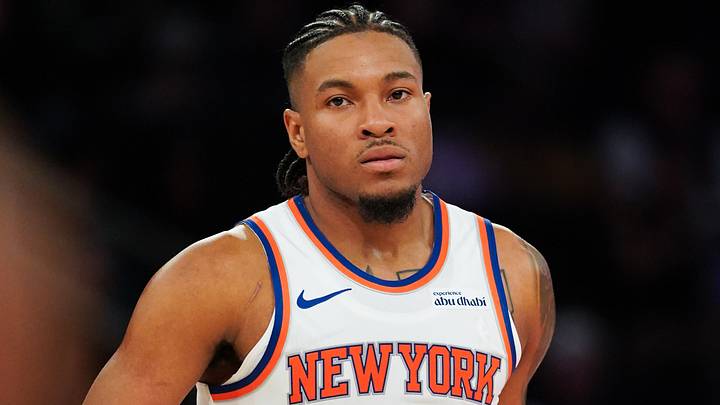
Miles McBride is the latest player to pay the price for Mike Brown’s experimental approach to the New York Knicks’ rotation. Unlike others in his situation, though, his latest role reduction points toward an eventual trade.
The thing is, by playing him less, New York will actually lower his market value—which, when you dig into the details, isn’t especially high to begin with.
Miles McBride’s minutes are down, and it might not be temporary
Reserve guard minutes were already tough to come by with Landry Shamet playing so well and Tyler Kolek emerging as the primary backup ball-handler. Reps are even harder to get now that Brown is dusting off the previously exiled Jose Alvarado, predominantly as a backcourt running mate for Jalen Brunson.
This has basically left McBride on the peripherals of the rotation. Over the last three games he’s logged a combined 31 minutes—10.3 ticks an appearance. That is a massive drop from the 19.2 minutes he averaged through his first 12 outings.
The downswing isn’t necessarily temporary, either. Sure, Brown shifts his rotation all the time. It’s part of the Knicks’ malleability, and their “stay ready” approach. (See: Clarkson, Jordan.) But if Shamet and at least one of Kolek and Alvarado emerge as mainstays, the playing-time squeeze is more difficult to reverse.
So many opportunities have also opened up because Josh Hart and Mikal Bridges are slumping. Unless you are betting these ruts to continue, their court time will only increase. That leaves McBride or one Kolek and Alvarado to be the odd man out.
This doesn’t help Miles McBride’s trade value
Lowering McBride’s minutes doesn’t completely torpedo his value. Teams around the league know he’s a capable three-and-D guard. At the same time, actively acknowledging he’s less valuable to you than last season isn’t going to invite attractive offers.
Remember, the Knicks are already working from a deficit in McBride talks. His sub-$4 million salary significantly shrinks the pool of players for whom he can be traded on his own. Combining him with other contracts doesn’t move the needle that much, either. New York is short on expendable matching salary.
Complicated still, McBride’s value is inherently lower because of his expiring contract. Even if he is cheaper to re-sign than many realize, teams know he’s not going to cost around $4 million forever. Trade offers will take into account that suitors only get a half-season with him before he receives a raise, or worse, leaves for nothing.
Oh, and then there’s the biggest kicker of all: The Knicks already cost themselves a ton of leverage in any trade negotiations when James Dolan foolishly signaled they wouldn’t ever enter the second apron.
Even if that’s the official stance, making it public is self-sabotage. Teams the Knicks speak with now know they have to move McBride, or lose him for nothing. New York could have previously played up the possibility it would keep him. It can’t anymore. Great job, Jimmy Kazoo.
Many of these sticking points tilt closer to moot if McBride is a heavily used member of a championship-contending rotation. That’s what he was last season. It’s what he’s been for much of this year, too.
At the moment, though, he’s tumbled so far down the pecking order that it doesn’t just bring his future with the Knicks into starker question. It jeopardizes their ability to make the most out of what already seemed like an inevitable exit.
 Add us as a preferred source on Google