

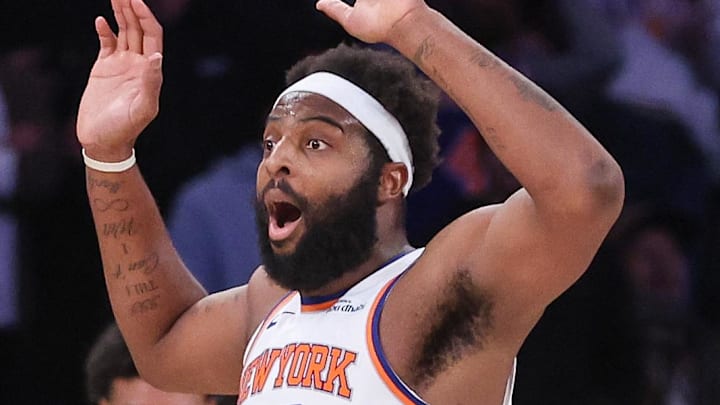
Next year’s NBA salary cap is reportedly clocking in $1 million lower than initially projected—a seemingly negligible amount that makes it substantially less likely the New York Knicks will want to run back this core for the 2026-27 season.
Don’t laugh. This is serious business. Well, actually go ahead and laugh. We’re here talking about a multi-billion-dollar enterprise founded around grown adults getting paid millions to put an inflated sphere through a circle. It’s inherently unserious.
But it’s also serious.
The Knicks are already working within spandex-tight financial margins ahead of next season. Without a major overhaul, they are going to be inside the second apron. They more than anyone else understand how $1 million makes a difference. The front office maneuvering beneath the second apron while acquiring Jose Alvarado and Jeremy Sochan was basically the “Super Mario avoiding danger” meme personified.

Delivering a similar masterstroke without making cuts was already going to be difficult, if not entirely impossible. This $1 million haircut is a stark reminder of that brutal reality.
The Knicks are going to get even more expensive
After factoring in the adjusted projections, New York is now an estimated $16.6 million below the 2026-27 second apron. Here’s the thing: That breathing room only accounts for nine contracts. It does not include the team’s 2026 draft pick(s), or a new contract for Mitchell Robinson.
It also doesn’t bake in deals for Landry Shamet and Mohamed Diawara, both of whom have earned themselves raises off their minimum salaries. If the Knicks wind up keeping them, Robinson, and signing their first-round pick for under $17 million combined, expect them to join the Los Angeles Clippers in being investigated for alleged salary-cap circumvention.
Put another way: New York isn’t avoiding the second apron if it keeps this core together. Even if Robinson comes cheaper than expected, the front office is a victim of its own success. Shamet and Diawara are excellent finds, and the world now knows it.
This doesn’t even begin to consider Jose Alvarado’s potential foray into free agency. He has a player option for 2026-27. If he declines it, the chances of him re-signing for $4.5 million or less next year are less than nil.
A $1 million difference could accelerate tough decisions
Entering the second apron isn’t taboo. You can say a lot of not-so-nice things about Knicks owner James Dolan. Most of them will be true. But he has never shied away from paying for talent.
Yet, based on comments he made earlier this season, even he might bristle at ponying up to retain this nucleus if it fails to win the championship. And while New York is a title contender, failing to hang a banner is the most likely outcome for every team’s season.
In the event this year concludes without a trophy, the Knicks have to weigh the risk-reward profile of running it back. Never mind the payroll, and subsequent tax bill. Diving into the second apron kneecaps their ability to improve. They will not have the mid-level exception in free agency, can’t take back more than they send out in trades, and won’t be allowed to aggregate salaries (unless they’re finishing underneath the second apron after the deal).
That last part is a biggie. New York will have two first-rounders to dangle in trade talks this summer (2026 and 2033), as well as swaps, and a juicy Washington Wizards second. Landing a difference-maker, particularly one with two MVPs on his CV, gets eons harder if you’re in second-apron territory.
Yes, the Knicks were always facing this dilemma. Knocking $1 million off next year’s salary cap won’t be the difference between keeping Robinson, and letting him walk. But it could be the difference between losing and re-signing Shamet or Diawara, or between having to offload Alvarado, Deuce McBride, or somebody else to grease the wheels of another transaction.
Slim margins matter in the era of aprons. The Knicks were already coloring within the thinnest lines possible, seemingly destined to make a move that knifes into the core. A smaller-than-expected salary cap only increases the chances, if inevitability, of that happening.
 Add us as a preferred source on Google