

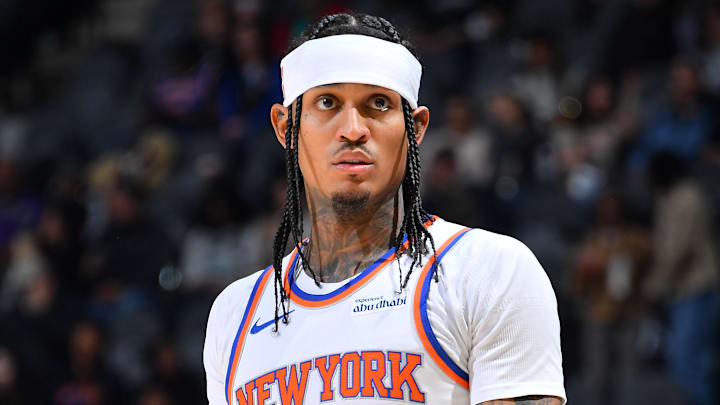
Karl-Anthony Towns brought up the departure of Cam Payne, unprompted, after the New York Knicks were annihilated by the Dallas Mavericks. His comments, while ill-timed, might help explain why Jordan Clarkson’s role is about to shrink.
And maybe even why, after logging under two minutes versus Dallas, his days in the Big Apple could be numbered.
When Newsday’s Steve Popper mentioned to Towns this is basically the same Knicks core as last year, the big man responded by saying, “I wouldn't say the same roster. That's disrespectful to guys that were here last year that were the real heroes of our season, the Cam Paynes, and all the other guys who came through when we really really needed them.”
Make no mistake, there is a level of ridiculousness to KAT’s comments. Around 86 percent of the Knicks’ minutes are being filled by players from last season’s squad. Just four teams are relying on a larger share of roster continuity.
Towns went out of his way to credit Payne. That is at once hilarious and tactless—and also makes sense.
Jordan Clarkson doesn’t optimize Karl-Anthony Towns
Payne was a premier driver of offense for Towns in New York’s secondary lineups. Despite ranking eighth on the team in minutes, he threw more dimes to the seven-footer than anyone other than Jalen Brunson, and Josh Hart.
Though Towns’ efficiency alongside Payne didn’t skyrocket, his volume exploded in these stretches. His scoring increased by nearly 13 points per 100 possessions next to the point guard. He also shot over 50 percent on twos off passes directly from Payne, and better than 40 percent on threes. This was not true for anyone else on the team, Brunson and Hart included.
I understand the scoffing at KAT’s Cam Payne shoutout, but FWIW, Payne prioritized KAT in the 2nd unit more than any player on current roster, and was a key part of those non-Brunson lineups that dominated the league last season.
— Rit Holtzman (@BenRitholtzNBA) January 20, 2026
Voiced that concern when they signed Clarkson. https://t.co/rIcoUTmCZF pic.twitter.com/VRVc1lCfZD
Explaining away KAT’s volume bump by noting many of his minutes next to Cam came without JB is fair game. The volume of passes he caught from him, as well as his efficiency off those looks, is a different story. Payne made a concerted effort to not only get Towns the ball, but make those decisions at a quicker cadence.
Clarkson isn’t doing the same. KAT’s usage spikes alongside him, but that says more about JB’s absence in many of their minutes. His efficiency remains virtually unchanged, and there isn’t a measurable two-man game between them. Just 12.4 percent of Clarkson’s passes go to Towns, which is a far cry from the 20.4 percent of Payne’s passes that found their way to the center.
Jordan Clarkson’s role may be in jeopardy
To be fair, Clarkson wasn’t brought on to be the Knicks’ most senior setup man under Brunson. He expanded his passing portfolio with the Utah Jazz, but never was, and never will be, a floor general.
Clarkson’s primary value is as another ball-handler and scorer in minutes without JB. Yet, with KAT having the worst season of his career, those stretches are now mission critical to getting him back on track. Clarkson isn’t equipped to do that.
Of course, the same can be said for the rest of the roster. Tyler Kolek is the closest these Knicks get to a KAT whisperer, but he’s not giving Mike Brown enough reasons to trust him. If you’re looking for the catalyst behind New York’s longstanding search for another playmaker, it’s right here.
Lightening Brunson’s workload is a factor, too. Ditto for increasing overall depth. But unless the Knicks plan to trade KAT, landing another playmaker is just as much about him as anything or anyone else.
And frankly, whether he stays or goes himself, that’s bad news for Clarkson.
 Add us as a preferred source on Google