

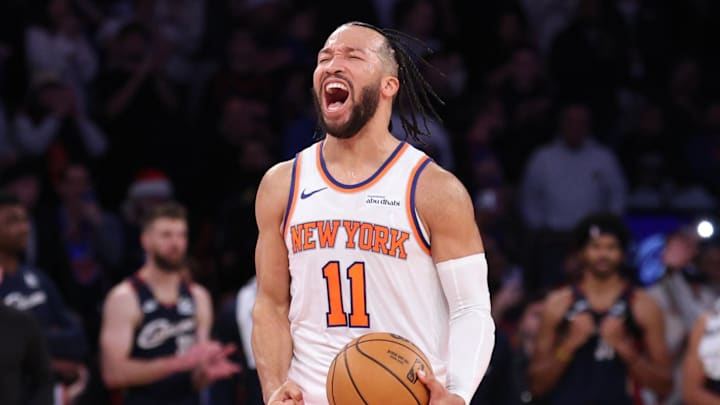
No matter which corners of the internet you tend to occupy, you have undoubtedly stumbled across someone claiming that Jalen Brunson doesn’t pass enough, or do enough to elevate the play of those around him beyond commanding incalculable amounts of defensive attention. Heck, in a particularly impassioned moment, you might have bought into the narrative, maybe even advanced it.
That’s okay. It happens. Just know that it’s not true.
Brunson will never be the most prolific passer, or even the quickest decision-maker. Part of that is a stylistic choice. Some of it is a necessity. He’s strong, but standing 6’1” without shoes, he doesn’t have the same sight lines as bigger primary ball-handlers. The average energy expenditure for him to do, well, anything is bound to be higher.
Even so, the idea that his playmaking talent or tendencies limit how the New York Knicks operate, as well as their overall ceiling, is a flat-out falsity. And if this were ever in doubt, Brunson’s recent passing exploits are putting it to bed now.
Jalen Brunson is on a playmaking tear
Prior to the All-Star break, the Knicks’ captain was averaging 6.1 assists. Since then, he’s at 8.1 dimes. His playing time is up, from 34.6 minutes per game to 35.9, but that’s not a large enough increase to be the primary catalyst behind his uptick in assists.
This is more about the quality of Brunson’s passes than the volume of them. He’s actually deferring less frequently out of his drives, and the number of passes he’s throwing per 36 minutes are about the same (65.1 pre-All-Star; 66.3 post-All-Star).
More of his passes, though, are leading to scoring opportunities. The NBA’s tracking data has a stat called assist-to-pass percentage adjusted, which is simply the percentage of passes by a player that are assists, free-throw assists, or secondary assists. Brunson had a 12.4 assist-to-pass percentage adjusted entering the All-Star break. He’s at 15.1 in the latter half of the season. That seems like a small spike, but it’s a 21 percent upswing from his pre-All-Star baseline.
This tracks with what we’re watching. Brunson seems to have shifted his mindset. Anecdotally speaking, it feels as if he’s more in tune with his peripheral vision during live dribbles, in both transition and the half-court. Though he’s not necessarily holding the ball less, it does look as if he’s throwing more touch-type passes upon catching it.
It shouldn’t come as any surprise that Brunson is making this tweak. Between his own recent struggles from the floor and the up-and-down performance of the offense, the Knicks have needed him to hit a different gear.
This is a necessary shift from Brunson
For all his flaws, Brunson is nothing if not self-aware. He has not shied from taking ownership of losses or acknowledging the need to play-make more often in the past. He has also proven to be more adaptable than most think.
What’s happening now is an extension of that self-awareness and adaptability. It covers many of the pain points from Knicks fans, too.
Brunson’s fourth-quarter scoring dominance is Clutch Player of the Year material, but people have also lamented the predictability of his buckets-first approach. Well, since the All-Star break, he’s assisted on 54.5 percent of New York’s made baskets in the final frame, up from 33.7 percent beforehand. It just so happens the Knicks have the best fourth-quarter offense during this span.
Oh, and who can forget the (legitimate) gripes about his chemistry with Karl-Anthony Towns. Brunson’s connection with his big man will never be perfect, but he’s finding him more often. Just 12.9 percent of KAT’s buckets came off JB dimes before the All-Star break. That share has pretty much doubled since, reaching 25.7 percent.
This doesn’t prove the Knicks and their point man are now Teflon. They have other issues. Slow starts have been their not-so-quiet killer in recent weeks. Injuries and cold streaks from the floor are dappled throughout the roster. Perception of Towns and Mikal Bridges, specifically, seem to fluctuate by the week, sometimes the game.
If anything, New York is just as, if not more, dependent on Brunson than it was last season. That’s not ideal, but he can clearly handle it—as both a scorer, and a floor general.
 Add us as a preferred source on Google