

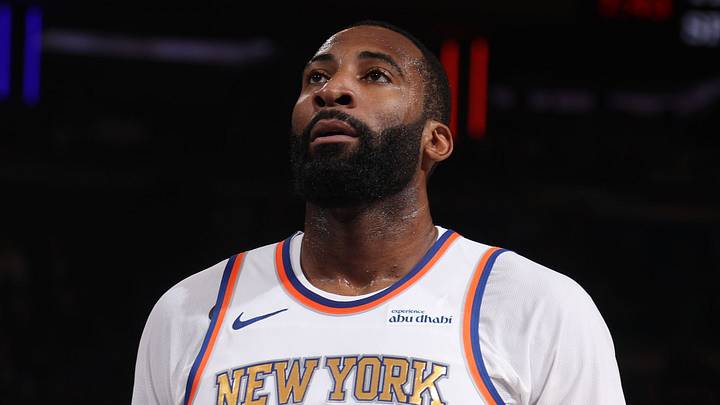
No question has loomed larger this offseason about the New York Knicks' roster than how they plan to replace Mitchell Robinson. Even if one were to put aside the length of Robinson's tenure, he was an essential piece of the puzzle as New York's backup center and interior anchor. The answer to that question appears to be Andre Drummond—imperfect a replacement as he may be.
Though it's only one game, what the 2026-27 regular season opener proved was that different doesn't necessarily mean bad in terms of how Drummond will replace Robinson.
Drummond finished his first game with the Knicks with a complete stat line and a healthy array of moments of intrigue. He tallied 12 points, 14 rebounds, four assists, two blocks, one steal, and an overwhelming seven offensive boards in 24 minutes of play.
Drummond shot just 5-of-14 from the field and struggled during the second half, but he also dominated the first two quarters when no one but Jalen Brunson was really thriving for the Knicks.
That's become the new situation for the Knicks to navigate. Drummond may not be a late-game player, but he shouldn't be expected to finish games that Karl-Anthony Towns is available for anyways. Typically, starters close games out—not the reserves.
That makes the manner in which he provided aid to the Knicks' cause all the more important to highlight rather than pick apart—and proof that different isn't always bad.
Andre Drummond is different from Mitchell Robinson—but it's not all bad
Drummond and Robinson certainly share similarities, as both are elite offensive rebounders and high-level screen setters. While Robinson is a generational shot-blocker and elite all-around defensive player, however, Drummond isn't necessarily known for excelling in those areas.
That's posed the aforementioned question about whether or not Drummond can fill Robinson's shoes and keep the Knicks trending in the same championship-winning direction.
The element of this discussion that's been commonly overlooked, however, is that winning a second title doesn't necessarily require a team to emulate the same formula that worked the first time. In many cases, making changes is essential to being able to win again—particularly when everyone now knows what worked for you the previous season.
That's where Drummond comes into play as a better passer, interior scorer, and shooter than Robinson. For instance: He buried 32 threes on 35.6 percent shooting in 2025-26.
Yes, factoring this all in will call on head coach Mike Brown to get creative—and for Drummond's new teammates to understand that he isn't a Robinson clone. Every team faces new challenges when a new season rolls around, however, and writing Drummond off as a downgrade is too simple an explanation for what truly transpired.
New York embraced the need for continuity in key areas such as offensive rebounding and screen-setting proficiency, but they also understood how valuable change can be.
 Add us as a preferred source on Google