

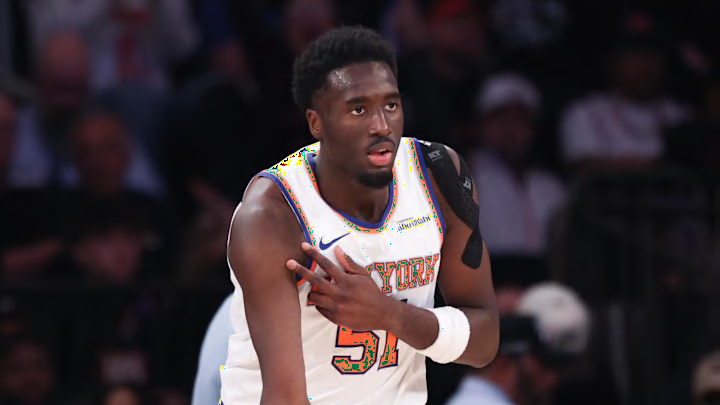
The New York Knicks have one of the best perimeter trios in the NBA with OG Anunoby, Mikal Bridges, and Josh Hart. All three are capable of playing tremendous defense while offering well-rounded value on the offensive end of the floor.
The unfortunate flaw that's hurt the Knicks since they joined forces, however, is a glaring lack of ideal depth behind them along the wings and at forward. Thankfully, Mohamed Diawara has bailed them out.
Anunoby, Bridges, and Hart played enough minutes under former head coach Tom Thibodeau that New York's lack of wing and frontcourt depth was often masked. Its guard-heavy rotation, however, has both strengths and weaknesses that no coach can permanently hide.
That ultimately resulted in the margin of error for Anunoby, Bridges, and Hart effectively amounting to zero, as the Knicks lacked the ideal talent to put alongside Jalen Brunson when they weren't thriving.
6'5" guard Landry Shamet has helped in some regard, but the need for consistent quality at forward has persisted. Guerschon Yabusele was meant to address that issue as a key offseason signing, but he never seemed to receive the opportunity to play his game under head coach Mike Brown.
Thankfully, just when it seemed as though the failed Yabusele experiment and the sustained inability to field ideal depth would cost the Knicks a shot at a title in 2025-26, Diawara saved them from their mistakes.
Mohamed Diawara creates the forward depth Knicks consistently lacked
New York clearly deserves credit for scouting, drafting, and developing Diawara. He was selected at No. 51 overall in the 2025 NBA Draft, however, and signed to just a one-year deal with an Exhibit 10 clause that seemingly implied the Knicks weren't entirely sure he'd fit with them in 2025-26 or beyond.
Considering it wasn't until a week before Christmas that Diawara played even 13 minutes in a single game, and had only exceeded 10 twice before that, it's safe to say he wasn't in their immediate plans.
The struggle to incorporate Yabusele and the decision to ultimately trade him, however, opened the door for Diawara to step up. Thankfully, that's exactly what he's done. His minutes have fluctuated, but his energy, intensity, and determination have made him a fan favorite.
Diawara has become undeniable in recent weeks, thus resulting in an increase to 15.9 minutes per game over his past 12 appearances as a sudden and nightly factor in Brown's rotation.
Knicks desperately needed size, assertiveness, and depth in frontcourt
The 20-year-old rookie has rewarded Brown's investment of playing time by emerging as a fearless and efficient shooter. He's averaging 7.0 points, 2.2 rebounds, and 1.7 three-point field goals made per game over his past 12 appearances while shooting 42.6 percent from beyond the arc.
Diawara has buried at least two three-point field goals in six of the nine games during which he's played at least 10 minutes during that time.
It's been the ultimate saving grace for a team that has a grand total of four players who are at least 6'6" and averaging at least 10.0 minutes per game. Those players are Anunoby, Bridges, and centers Mitchell Robinson and Karl-Anthony Towns.
It should thus come as no surprise that the Knicks rank No. 29 in bench points per game, as well as points via forward reserves, in 2025-26. Thanks to their breakout 6'9" forward, however, the Knicks are finally beginning to run out rotations with the size and depth they need to truly compete.
At 9-2 when Diawara plays at least 15 minutes and in possession of an invaluable win over the Boston Celtics during which he tallied 10 points in 27 minutes, the Knicks finally have reason for confidence.
 Add us as a preferred source on Google