

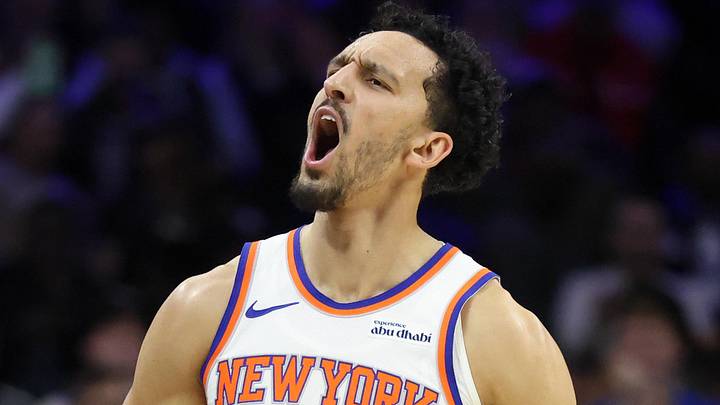
Landry Shamet going off in the NBA playoffs and Finals is more than just a much-needed boon for the New York Knicks’ immediate championship chances. It’s also proof that this team has what it takes to stick around for the foreseeable future by finding talent in the only place they’ll be permitted to shop: the bargain bin.
This isn’t a Knicks dynasty forecast. They have yet to get past the San Antonio Spurs. There’s work left to be done, the kind of unfinished business that necessitates living in the moment.
Still, New York is already thinking about next steps. Making the Finals has, apparently, ensured they will retain Shamet using his Early Bird rights—which they are lucky to have—and Mitchell Robinson, and cannonball right into the second apron.
This willingness to spend for the sake of preserving a championship core is important. Other teams wouldn’t be so apt to break open the piggy bank.
Yet, while the financial cost will be steep, the logistical hurdles are actually the biggest roadblock toward sustained contention, and overall improvement. Shamet is proving the Knicks are up for the challenge.
Adding talent is about to get a lot harder for the Knicks
Entering the second apron subjects New York to a ton of roster-building limitations. It cannot aggregate salaries in a trade. Nor can it take back more money than going out in any deal. And perhaps most importantly, it will not have access to any mid-level exception. That includes the mini MLE (worth $6 million this summer) it used to sign Guerschon Yabusele last offseason.
This won’t seem like a huge deal thanks to the player we just cited. The list of mini MLE signings that go on to have a real impact is sparse. Even so, having $6 million to dangle beats peddling only minimum contracts—which, if they enter the second apron as planned, is all the Knicks will have.
This creates massive challenges when fleshing out the rotation. Yes, New York is deep right now. It’s running out Mikal Bridges-without-any-other-starters lineups in the Finals for crying out loud. That depth isn’t disappearing overnight if the Knicks bring back Shamet and Robinson.
At the same time, even the deepest squads get run down. Karl-Anthony Towns being the oldest of the core players, going on 31, is great news. But this is less about age, and more about mileage.
New York will be working off two conference finals-or-deeper postseason runs heading into next year. This doesn’t even factor in the minutes Jalen Brunson and Josh Hart racked up under Tom Thibodeau prior to the arrivals of Bridges, Towns, and OG Anunoby.
It’s not like the other three were shouldering lighter loads away beforehand, either. Towns has been to at least the conference finals in three straight seasons. Bridges hasn’t missed a game since, approximately, dinosaurs roamed the Earth.
The Knicks need to replenish the talent pipeline
Over the past four years, Brunson, Hart, and Bridges make up three of the most used players in the entire league. So yeah, the Knicks are going to need reinforcements. Even if they’re assured pristine health (they’re not), they need to extend the rotation further, carving out ample opportunities to lighten the workload and outright right their most important players in the regular season.
Barring a shocking development, they’ll have only league-minimum contracts to do it. First- and second-round picks will be sprinkled in throughout, but there’s a cap on how much rookies contribute to established contenders. (Just ask Mohamed Diawara.)
Luckily for the Knicks, they’ve already shown they can hit on these margins. Shamet is one of the seven most important players in a rotation that’s likely going to win the championship. Even Jordan Clarkson’s evolution into a try-hard offensive rebounder and defender is proof of New York’s resourcefulness. Both are on minimum contracts.
Not only that, but the roles JC and Shamet chiseled out send a message to other free agents: The Knicks will find ways to play you. That may seem like a small thing on the surface, but if you’re pitching impact vets with mini-MLE offers on the table, it can make a world of difference.
After all, given how much more than the minimum he’ll get this summer, who wouldn’t want to be the next Landry Shamet?
 Add us as a preferred source on Google