

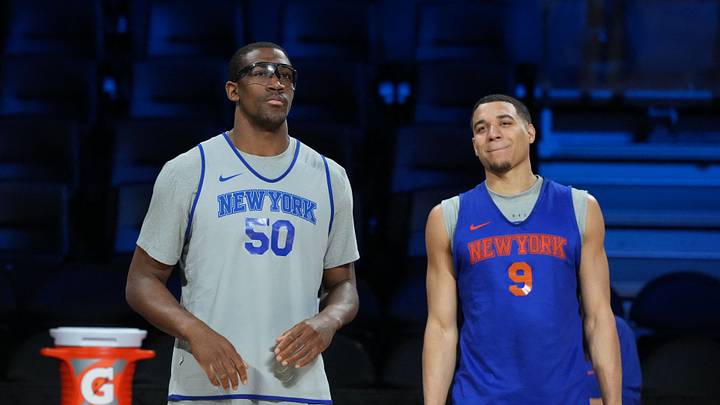
Losing Trey Jemison III to the Toronto Raptors on a two-way contract does not immediately have huge on-court implications for the New York Knicks. Sure, it costs them potential in-house depth at the currently shallow center position. But Jemison would have topped out as a break-in-case-of-emergency option.
The 26-year-old’s exit is notable, if not critical, for another reason entirely: New York can no longer use him in a sign-and-trade to land a better center, or just a general roster upgrade.
At this point, you are probably thinking: Who would want to sign-and-trade for Jemison when he couldn’t get more than a two-way contract in August? This is a fair thought. But a theoretical sign-and-trade with Jemison wouldn’t be about him specifically. It’d be about increasing the amount of outgoing money so the Knicks can, in turn, take back more money of their own.
Most will consider this strategy a pipe dream. New York’s wealth of open roster spots begs to differ. The Leon Rose-led front office feels like it’s up to something. If it wasn’t, why wouldn’t it have already burned a roster (or two-way) spot on rookie Tyler Nickel, rather than risk him returning to college?
The Knicks have fewer sign-and-trade assets after losing Jemison
Fortunately for the Knicks, they have other players they can use to drive up outgoing salary. Four other unsigned cap hits currently remain on their books for Dillon Jones, Kevin McCullar Jr., P.J. Tucker, and the 38-year-old Petteri Koponen, who was drafted 30th overall in 2007 and never came stateside.
These players can all be signed-and-traded to contracts that include only one guaranteed year on a three-season deal. And while base-year-compensation would typically be an issue, the Knicks can get around that by offering minimum salaries, which count for their full outgoing value.
In Jemison’s case, because he’s entering his fourth NBA season, this would have allowed New York to ship him out at a value of $2.6 million. That may not sound like much, but it could be the difference between keeping Tyler Kolek or having to jettison his $2.3 million salary as part of another trade.
Minimum salaries for Jones and McCullar would also take care of the difference. The same goes for Koponen, whose $3.2 million cap hit is about $100,000 less than the wiggle room the Knicks have below the second apron.
Still, losing Jemison now limits the number of sign-and-trades New York can cram into one deal. Tucker already can’t be included, because his minimum salary ($3.9 million) exceeds the amount of space the Knicks have beneath the second apron. And since any contract in a sign-and-trade must be at least three years in length, he would count for the full $3.9 million freight. Veteran minimums only get lowered to $2.5 million as part of one-season deals.
By losing Jemison, then, the Knicks are effectively down to three sign-and-trade filler options. That might be enough to finagle the acquisition of a higher-end backup center if Deuce McBride is involved. Without Jemison, though, the path to making such a move without including McBride or Kolek just got a little to a lot more difficult.
 Add us as a preferred source on Google