

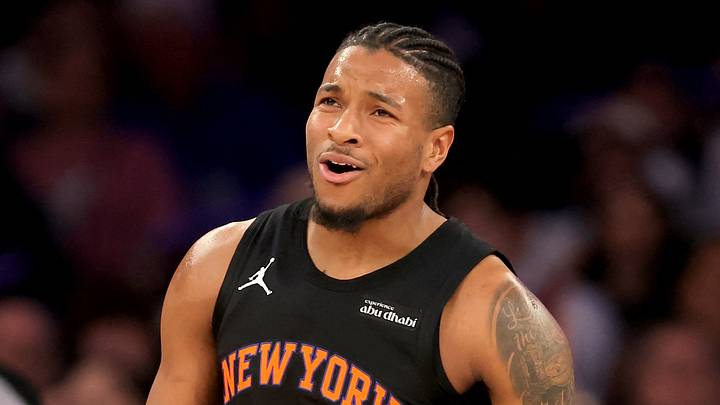
The New York Knicks have a Miles McBride problem. The 3-and-D combo guard will become a free agent next summer and the Knicks will need to either free up money or potentially go into the second apron to re-sign him—a possibility that has already cost New York Mitchell Robinson and, theoretically speaking, Cameron Carr.
A common reason many believe the Knicks should trade McBride instead of extending him, however, isn’t money. It’s size. As an undersized 2, critics have come to the conclusion that he simply doesn’t fit with Jalen Brunson.
Those critics are ignoring context.
Yes, Brunson and McBride both stand at 6'2". And yes, that should make them a difficult duo to put on the court together. To put it simply: An undersized backcourt is a recipe for disaster in an NBA that seems to be favoring size above all else.
James L. Edwards III of The Athletic acknowledged that perceived issue when discussing McBride’s future with the team.
“McBride is a good player, but the Knicks do have one of the league’s smallest backcourts. They have three rotation players listed at 6 feet 2 or shorter: Brunson, McBride and Jose Alvarado (and Tyler Kolek is also on the smaller side). Also, McBride is more of a shooting guard than a point guard, and with Landry Shamet in the fold, it’s possible New York could see McBride as more expendable.”
For as valid as that concern may seem, there’s a fundamental flaw in the argument: Brunson and McBride have produced dominant results when they've shared the court.
Jalen Brunson and Miles McBride are actually a dominant undersized duo
Brunson and McBride shared the court for 1,161 possessions in 2025-26, per Cleaning the Glass. During that time, New York outscored opponents by 15.1 points per 100 possessions. That net rating ranked in the 98th percentile of the NBA.
The Knicks were remarkably balanced during those possessions, dominating on offense and turning in above-average defensive results, as well.
With Bruson and McBride on the court, the orange and blue ranked in the 100th percentile in offensive rating, the 85th percentile in eFG%, the 95th percentile in turnover percentage, and the 90th percentile in offensive rebounding percentage. In other words: New York was elite in virtually every phase of the offensive game.
Furthermore, the Knicks were still in the top half of the league in defensive rating with Brunson and McBride on the court, ranking in the 53rd percentile.
Yes, the Knicks' backcourt is small—but it's remarkably effective
A key question admittedly exists: Can Andre Drummond truly fill the Mitchell Robinson role? In 410 possessions with Robinson on the court, the Brunson and McBride duo maintained its offensive proficiency—100th percentile in net rating and offensive rating—while also ranking in the 86th percentile in defensive rating.
Drummond isn’t quite the defender that Robinson is, but if he can hold his ground, that could prove sufficient and help this duo continue to thrive when Karl-Anthony Towns sits.
Throw in the fact that McBride can stand on his own two feet as an elite shooter and competitive defender, and extending him should be a priority. He’s a homegrown talent who has proven adaptable and amenable to just about every role he’s been challenged with.
Cost will inevitably play a decisive role in extension conversations, but trading McBride because of his size would ignore the truth about how dominant he and Brunson are as a backcourt duo.
 Add us as a preferred source on Google