

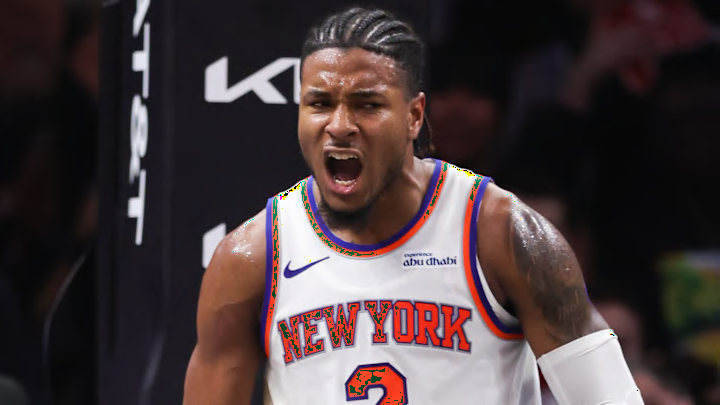
Deuce McBride is going to find his name in trade rumors at some point. But if the New York Knicks’ previous dealings are any indication, we already know what’s about to happen.
He’s not going anywhere.
No, team president Leon Rose has not come flat-out and said it. And all bets are off if New York stumbles into what it deems a can’t-miss blockbuster opportunity.
Even so, it’ll be a genuine shocker if McBride is shipped out before the February 5 deadline. And this isn’t so much blind conjecture as an informed guesstimate thanks to…Immanuel Quickley, and Julius Randle.
The Knicks’ previous actions point to a clear Deuce McBride decision
Under Rose’s C-Suite regime, New York typically hasn’t moved off key players it’s unsure about until they enter contract years. Randle was traded the offseason before he had a player option, and could enter free agency. Quickley was sent to the Toronto Raptors as part of the OG Anunoby deal months before reaching restricted free agency.
Exceptions exist. None of them are the rule.
The Knicks let Anunoby reach free agency after acquiring him because he was never going to sign an extension based on his previous salary. Donte DiVincenzo was jettisoned with three more years left on his deal only because the team was smitten with a seven-foot All-NBA center.
McBride’s future falls into the same bucket. The Knicks don’t have to figure out his future now, because he’s on the books for another year—for a rate, mind you, that makes it prohibitive to move him at all.
New York will address Deuce’s future over the offseason…at the earliest
Deuce became extension eligible as of Dec. 30. The Knicks can sign him to a deal worth up to 140 percent of the estimated average player salary. As of this summer, a max extension for him would clock in at four years and around $95 million. New York doesn’t have to—and assuredly will not—give him the full boat. The point is, it has the ability to keep him.
This front office is no stranger to extending players to keep them off the open market, either. Jalen Brunson, Josh Hart, Mikal Bridges, RJ Barrett, even McBride’s present deal itself are all proof. And those deals all came when each player had just one guarantee year left on their current contracts.
If the Knicks decide over the summer that retaining McBride won’t be cost effective beyond next season, that’s when you can expect them to shop him. And even then, Rose and company might be compelled to break character and let it ride, not unlike they have so far done with Mitchell Robinson.
McBride is that cheap.
After making just $4.3 million this season, he is on the books for even less 2026-27, at $3.9 million. New York is not positioned to surrender that type of team-friendly control without thinking twice, if not a kajillion times.
Impact players on cheapo deals are low-key lifebloods for NBA title contention. The Knicks could be staring the second apron and all its roster-building restrictions right in the face next season. Having a legitimate top-six rotation player already on the books, at under 2.4 percent of the salary cap, is beyond massive.
Keeping him into next year without an extension is loaded with more risk. The Knicks must take that into account. Whatever they decide, though, the precedent has already been set: The decision isn’t coming before this summer.
 Add us as a preferred source on Google