

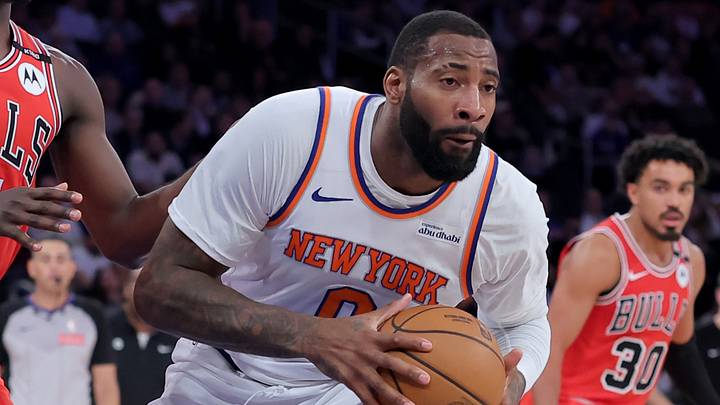
As much as the early season focus remains on the New York Knicks’ need to eventually acquire another big man, they have to figure out how to make the most of Andre Drummond in the interim. And really, it may need to be longer than that.
Nobody at this stage can guarantee, beyond a shadow of a doubt, the Knicks will trade or land a backup center better than Drummond. They must be prepared to optimize his impact for the long haul.
Fortunately for them, the Philadelphia 76ers already laid the blueprint by letting him take corner threes.
Letting Andre Drummond take threes isn’t just about him
Drummond attempted a career-high 90 three-pointers last season. Seventy-seven of those looks came from one of the corners, where Drummond shot a combined 37.7 percent.
That isn’t an elite mark, but it’s good enough. The league average from the corners outside garbage time last year was 38.8 percent.
And yet, Drummond’s raw efficiency doesn’t matter as much as the extra space putting him in the corner creates.
Defenses will never treat him like a five-alarm fire, but some teams will leave a body near him. That automatically creates more wiggle room for guys like Jalen Brunson, Landry Shamet, and Josh Hart—the three players who’ve spent the most time alongside Drummond this season.
New York’s offense needs that additional runway right now.
Brunson has seen his two-point efficiency dip by seven percentage points in his minutes with Drummond. Hart’s inside-the-arc clip has plunged by more than 20 points, going from 53.8 percent to 33.3 percent. Shamet doesn’t take a ton of twos, but his efficiency has nosedived by 19 points, dropping from 44.4 percent to 25 percent.
Spacing Andre Drummond out covers up his own weaknesses
Putting Drummond in the corner takes him out of the paint, where he not only clogs up jump-shot sightlines and driving lanes, but also can’t finish. He is shooting a disastrous 55 percent at the rim, and has missed all six of his short mid-range looks.
This is troubling enough to make using Drummond in the corners a productive gambit almost no matter what. Even if he doesn’t replicate last year’s efficiency, the Knicks are better off having him shoot 30 percent from the corners while opening the lane for Brunson, Hart, and OG Anunoby.
At this point, the downside is minimal. Sticking Drummond in the corner will lower his offensive rebounding rate, but he managed to rank inside the 93rd percentile of friendly-fire recoveries last year. And frankly, plopping him in the corner stands to pay more dividends than hoping he can do more as a passer.
There is always the chance it doesn’t work. If it flops, then so be it. Until or unless the Knicks acquire someone who can do more as a vertical spacer and interior finisher, though, using Drummond more like the Sixers did is worth a shot.
 Add us as a preferred source on Google