

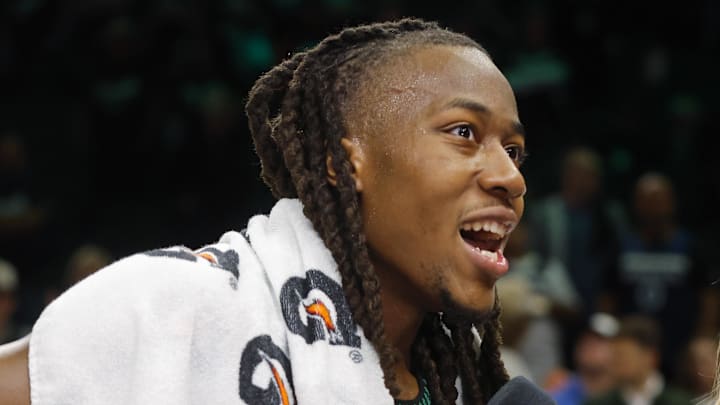
As the New York Knicks enter what may very well be their second-to-last postseason appearance with Miles McBride on the roster, they must learn from the Ayo Dosunmu saga. Dosunmu was drafted and developed by the Chicago Bulls, but after being traded to the Minnesota Timberwolves in 2026, he reached a level the Windy City franchise may not have realized he could.
As McBride nears the end of the second of three years on his current contract, the Knicks must ensure that he's given every opportunity to show how far his upside truly reaches.
The Bulls could only sit and watch as Dosunmu scored a name-making 43 points during Game 4 of the Timberwolves' first-round series against the Denver Nuggets. It was an eye-opening performance that came mere days after he scored 25 points during Game 3.
It was the epitome of an eye-opening display from a player who quietly averaged 19.6 points per 36 minutes during a career-best 2025-26 regular season.
Despite the fact that Dosunmu produced well and shot 43.9 percent from beyond the arc in 2025-26, he played just 26.4 minutes per game across his 45 appearances with Chicago. That was a drop of 3.9 minutes per contest from 2024-25 and displayed a fundamental truth Bulls fans know all too well: He never really got a fair chance to reveal how high his ceiling truly was with the team that drafted him.
Thankfully, the Timberwolves have positioned Dosunmu to reveal his true potential. The Knicks must take notes and give McBride the same type of opportunities before it's too late.
Knicks must explore Miles McBride's true potential before it's too late
McBride ranks among the best bargain players in the NBA. He's playing on a front-loaded three-year, $13 million contract that's paying him $4,333,333 for the 2025-26 season and will see him make just $3,956,523 in 2026-27.
Once McBride ultimately hits unrestricted free agency in 2027, he'll likely be looking for a larger salary—and could have a surplus of suitors.
With this in mind, the Knicks must figure out what his value truly is to the team by empowering him to feature prominently in the rotation. The seeds have certainly been planted, as he played a career-high 26.3 minutes per game and ranked No. 6 on New York in that statistic.
McBride also emerged as the Knicks' most lethal three-point shooter, ranking No. 1 on the team in both three-point field goals made per game (2.7) and three-point field goal percentage (.413).
The question, however, is how much more McBride can offer beyond operating as a sixth man and fourth or fifth scoring option. The Knicks are a uniquely deep team in the scoring department, but they must give McBride chances to prove how much more he's capable of before it comes time to determine his next salary.
Compounded by the eventual need to sell McBride on continuing to play for the Knicks, the time is now to learn from the Bulls' mistake with Dosunmu.
 Add us as a preferred source on Google