

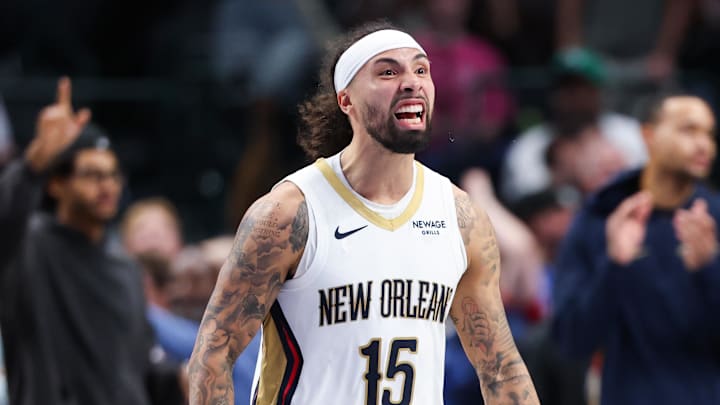
When the New York Knicks sent Dalen Terry and two second-round picks to the New Orleans Pelicans, Jose Alvarado was the primary asset coming back in the deal. He was not the only one.
After the dust of the trade deadline settled, The Athletic’s Fred Katz brought word that the Knicks also acquired the rights to Latavious Williams, the No. 48 pick in the 2010 NBA draft.
You are not alone if you’re wondering how a 36-year-old playing in the SBL, who has never made it to the Association, is going to help New York. The surface-level answer is he won’t. As Katz notes, the Knicks’ front office has made stockpiling these afterthought draft rights something of a bit—a transactional signature. That doesn’t mean they won’t one day be useful.
Throw-in draft rights have untold value
Draft rights along these lines serve a unique purpose: simplifying the construction and completion of deals that feature three or more squads.
Any team involved in a trade must send and/or receive something from every other participating party. This isn’t much of a roadblock for two- and even three-team deals. It gets a little more complicated as you expand the field.
This is where draft rights to someone like Latavious Williams comes into play. The Knicks can meet the “interact with every team” requirement by shipping him elsewhere. This alone isn’t going to net them an asset, but it’s an easy way to get a deal over the finish line without having to send out an asset holding more value, like an end-of-bench prospect or a second-round pick.
A team like New York potentially spares itself, in particular, from having to give up the latter by using draft rights. Sure, a top-55-protected pick is just as “fake.” But unencumbered second-rounders hold more value as assets in more straightforward transactions—like the acquisition of Jose Alvarado himself.
The Knicks may need draft rights this summer
If you’re still not sold on the potential importance of draft rights, well, I don’t blame you. But before you dismiss it, consider where the Knicks stand this coming offseason.
Assuming they bring back Mitchell Robinson, they are likely to vault into the second apron. That restricts them from aggregating salaries in any trade. Much like picks themselves, draft rights do not count as player aggregation. The Knicks can attach as many of them as they need to cherry-top a multi-team deal. And even if they are below the second apron, they still won’t be in a position to take back more money than they send out. Draft rights allow them to satisfy the “touch” requirement rather than needing to accommodate more inbound salary.
This tool cannot be underestimated. Especially given the current landscape. The Era of Aprons has increased the frequency with which three-or-more-team trades are going down. Intended or unintended, the logistics of this CBA haven’t nuked trade activity so much as complicated logistics.
For that matter, do you think it’s a coincidence Oklahoma City Thunder general manager Sam Presti acquired the rights to the little-known Balaa Koprovica from the Utah Jazz, just as his own team’s payroll is set to explode next year?
So don’t be surprised if the Knicks pursue a splashy move this summer, perhaps one the size of a two-time MVP, and Latavious Williams or one of their other many draft-rights tools are part of the process. Assets like this aren’t everything. They most of the time do nothing. But they can, in the Knicks’ case, absolutely mean something.
 Add us as a preferred source on Google