

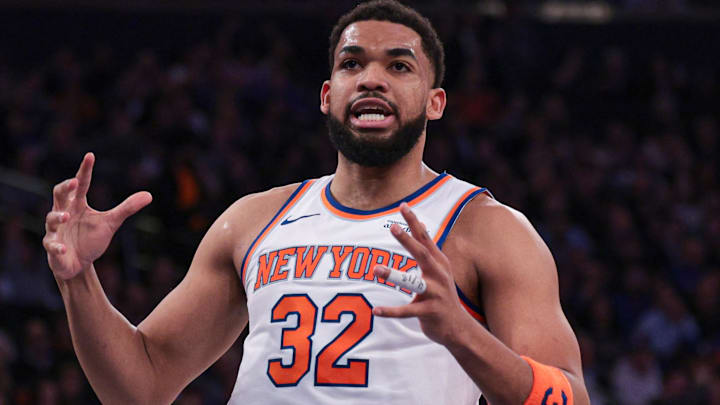
Between Deuce McBride, Josh Hart, and now Landry Shamet, injuries on the perimeter are beginning to pile up for the New York Knicks. Mike Brown’s response to this predicament should include rolling out the Karl-Anthony Towns-Mitchell Robinson frontcourt more often—even though it’s delivering less-than-stellar results at the moment.
To be sure, the season-long numbers for the duo are fine. The Knicks are outscoring opponents by 7.5 points per 100 possessions with them on the floor, while maintaining an offensive rating that would rank in the top 10. That’s no easy feat when more than half of the dual-big possessions are coming without Jalen Brunson.
Yet, New York is having a tougher go when playing both centers in recent weeks. Over the past month, the Robinson-Towns pairing has finished as a net positive just three times across their 10 appearances. Albeit only slightly, the Knicks in these stretches are a net negative overall.
This proves…nothing. Or close to it. The entire season’s sample size with the two totals just 256 minutes. Entire lineups generally need more than that to normalize—which is sort of the point.
The Knicks need more information on the KAT-Robinson twosome
For all the intrigue surrounding New York’s dual-big proposition, there continues to be a lack of extensive evidence. Including last year’s playoffs, the two have now logged a total of 456 minutes since KAT’s arrival. While the returns are promising—plus-8.1 net rating, with an offensive rating approaching 120—this sample is nothing in the grand scheme of two seasons.
Stress-testing it more often ahead of the playoffs should be a priority. The Knicks need to get a feel for how viable the KAT-Mitch frontline is across all sorts of matchups—not just big and physical teams, but quicker, athletic, smaller, et al. squads as well.
Perhaps more importantly, they need a sense of how viable KAT and Mitch can be together on offense. Though the raw data hints at operability, it is overly reliant on second-chance opportunities. The Knicks are averaging 0.953 points per first-chance possession with both bigs. Filter out last year’s results, and that drops to 0.951—the equivalent of the NBA’s worst offense.
Towns’ efficiency during these instances is the biggie. His average shot distance alongside Mitch (11.3 feet) is actually closer to the basket than without him (12.1 feet), but you can nevertheless feel the functional friction between the two when watching them. Defenses can pack the paint more easily, and KAT must work even harder on his drives inside the arc just to get off looks that are lower-quality than normal.
Now is the time for the Knicks to go big
Maybe there is no perfecting the offense with both Robinson and Towns on the floor. They don’t interact in the half-court all that often, and Towns’ lack of live-dribble playmaking makes it harder to establish a connection out of his drives or big-to-big pick-and-rolls.
Still, the Knicks won’t know for sure unless they expand the sample. And with so many bodies now banged up on the wing, turning to more dual-big arrangements is another way to preserve size.
Multi-guard alignments with two or more of Jalen Brunson, Jose Alvarado, and Jordan Clarkson are only so usable, and the Knicks were already thin at the wing spots before. Shamet is technically a guard himself, and spent time defending up. New York can and should bake in more Mohamed Diawara, but for the time being, he alone isn’t enough either.
Using KAT and Robinson on the frontline leaves New York with just the 2 and 3 spots to hash out. Failing a sudden desire to dust off Pacome Dadiet or Jeremy Sochan, that’s among the Knicks’ most palatable interim solutions, even when factoring in the potential trickle-down effect on the center rotation (i.e. more spot minutes from Ariel Hukporti).
Ultimately, though, this goes beyond navigating the current injury situation. It’s mostly about determining whether the KAT-Robinson partnership is a party trick only to be busted out on special occasions, or if it’s a dynamic the Knicks can lean on in larger, higher-stake bursts.
 Add us as a preferred source on Google