

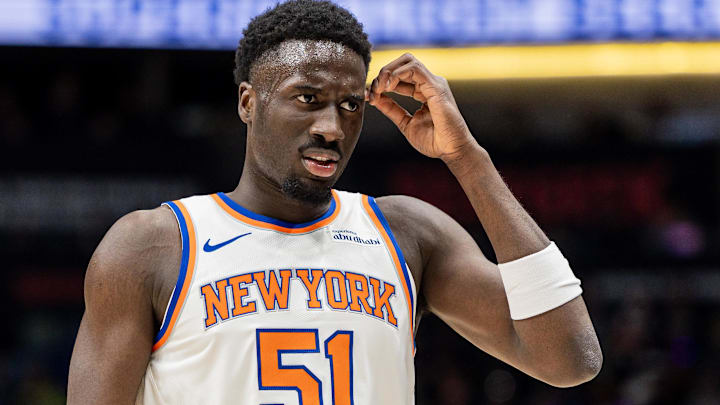
Mohamed Diawara long ago established himself as a swing factor in the New York Knicks’ long-term plans. Now, on the heels of Landry Shamet’s latest injury, he’s essential to the present.
After leaving New York’s near-miss against the Brooklyn Nets with a right knee injury, Shamet is slated to miss Sunday’s contest against the Washington Wizards. Though his absence may be rooted in an abundance of caution, the combination of his injury history and value he’s brought to the table renders any setback worthy of attention.
Especially now.
The Knicks are already navigating an extensive absence from Deuce McBride (sports hernia surgery), and Josh Hart has missed three of the past five games dealing with his own right knee issue. Head coach Mike Brown has seemed more willing to favor offense over defense at the expense of Diawara in recent days, but the fragility of New York’s wing rotation leaves him no choice other than to view the newbie as necessary—not just temporarily, either.
The Knicks aren’t that deep on the wings
Questioning the wing depth of a team with Hart, OG Anunoby, and Mikal Bridges feels bizarre. Icky, even. But the Knicks are wearing thin after them.
Neither Pacome Dadiet nor Jeremy Sochan has shown enough to earn regular minutes. Brown has not shied from downsizing with three-guard lineups, but not all of them are defensively viable, particularly with McBride on the sidelines.
Shamet has papered over the hole for much of the season in impressive fashion. Technically a guard himself, he has shimmed between the 2 and 3, and has the defensive-assignment list to prove it.
Losing him in tandem with McBride is also nightmarish for the Knicks’ screen navigation. No other two players do a better job reading, reacting to, or fighting against picks.
Jose Alvarado is the next best option. Exceptionally active on defense himself, he doesn’t have the size or strength to guard up as often as McBride or Shamet (mostly Shamet).
That leaves…Diawara. Brown cannot reasonably ask OG Anunoby to increase his own workload—not this late in the season, and certainly not when New York should be looking to manage the workloads of its top guys ahead of the playoffs. Nobody, meanwhile, needs to sit through another bloggity-blog lecture about Mikal Bridges’ shortcomings as a turn-the-water-off defender .
If the Knicks have any chance of even beginning to approximate Shamet’s two-way value, they’ll bump up Diawara’s minutes while he’s out. Beyond that, they should also be sure not to treat this as purely a short-term issue.
New York can’t just assume Shamet and McBride will get and stay healthy
Anunoby, Bridges, and a healthy Hart will do a lion’s share of the heavy lifting come playoff time. The Knicks nevertheless need reliable and prepared options after that.
McBride and Shamet both fit that bill. New York just can’t afford to operate as if they are its only solutions. Deuce will have not played in more than two months once he returns. It may take him some time to regain his defensive punchiness.
Even more critically, the Knicks cannot take Shamet’s wing minutes for granted. The way he competes on defense at times verges on reckless. Watch him navigate any on- or off-ball screen. He really uses his shoulder to get through and around guys.
This is equal parts admirable, and worrisome. Shamet has a history of left and right ankle injuries, and him leading with his shoulders is downright terrifying knowing he missed a bunch of time recovering from a dislocation on his right side.
The Knicks needn’t assume the worst-case scenario(s) will play out. But they better prepare like it. That entails leaning upon Diawara harder and more often. The rookie has cleared the 20-minute threshold four times so far. He should exceed the mark more often over the closing kick, all in service of extending his stamina, familiarizing him with more lineups, and most importantly, putting him in more critical situations.
To this point, just over 1.3 percent of Diawara’s minutes have come in high- or very-high-leverage situations. That needs to come up—even if it makes life harder for the Knicks, even if it costs them some ground in the win column.
Basically, New York needs to treat Diawara less like a luxury, and more like what the depth and dependability of its wing rotation is making him: essential.
 Add us as a preferred source on Google