

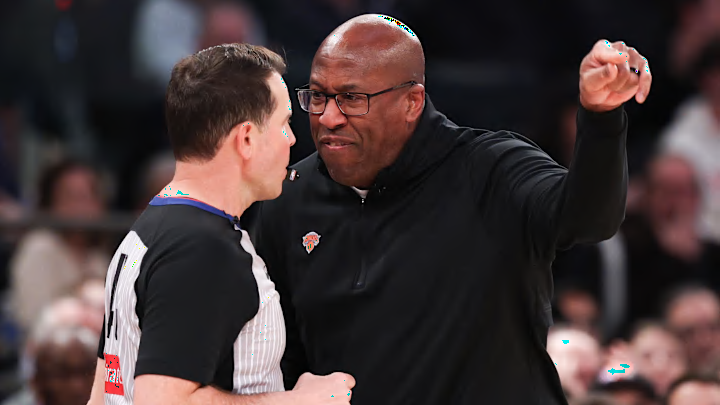
Mike Brown has delivered on most of the preseason promises he made after taking the reins of the New York Knicks. From more three-point attempts and ball movement to a deeper rotation and exploratory lineups, he continues to leave his intended marks—with one gargantuan exception: offensive pace.
New York’s head honcho waxed poetic about, among other things, the importance of playing faster relative to seasons past. Though the Knicks’ offense incorporates more variance and bestows more agency upon the collective, operating at a speedier clip is not among its hallmarks.
And given the makeup of this roster, it may never be.
The Knicks are not playing much faster than last year
Surface-level numbers show New York is playing with a tick more pace. After churning through 97.64 possessions per 48 minutes last year, the Knicks are up to 98.45 this season—a negligible uptick. The same goes for their overall transition frequency. Around 15.3 percent of their plays have come on the break, a slight increase over last season’s mark of 14.5 percent.
Speed isn’t measured purely by transition frequency. Teams can play uptempo without living on the break. Half-court actions can get faster, and field-goal attempts can come noticeably earlier in the shot clock.
That isn’t happening in New York, either.
Roughly 21.9 percent of the Knicks’ attempts last season came inside the first eight seconds of the shot clock. That number is virtually unchanged now. Just under 22.5 percent of their looks come within the first eight seconds of the shot clock, the 19th-best mark in the league.
This keeps in theme with their overall average offensive process. New York uses 14.5 seconds on the typical possession. That is up from last year (15.2 seconds), but its ranking relative to the rest of the league remains virtually unchanged (25th, up from 27th).
No, Mike Brown has not failed the Knicks
The speed (or lack thereof) at which the Knicks are operating is not evidence of malpractice. They have the third-most efficient offense for crying out loud.
This is instead a reality of their roster. New York is not built to play fast. For as much as Jalen Brunson has adapted (mostly under the radar), he is not hard-wired to work at warp speed in the half-court. The same goes for Karl-Anthony Towns. Ditto for Mikal Bridges (when he’s on-ball, anyway).
Most of the guards and wings will look to push after rebounds. That is about the extent of the Knicks’ uptick in pace. And while certain players would love to sprint up and down the floor (a la Josh Hart), none of them have large enough control over the offense to implement it as an identifying principle.
This might not matter in the end. The Knicks get up more threes, they are better at driving and spraying, and their two-way peak this season is higher than last year. Still, with the offense returning less-than-apex results since the All-Star break, the cadence at which they have to play is worth monitoring.
Using speed as an audible could be integral to playoff success. Right now, that option isn’t ingrained into the Knicks’ DNA. And with this exact core in place, for better or bare, it’s never going to be.
 Add us as a preferred source on Google