

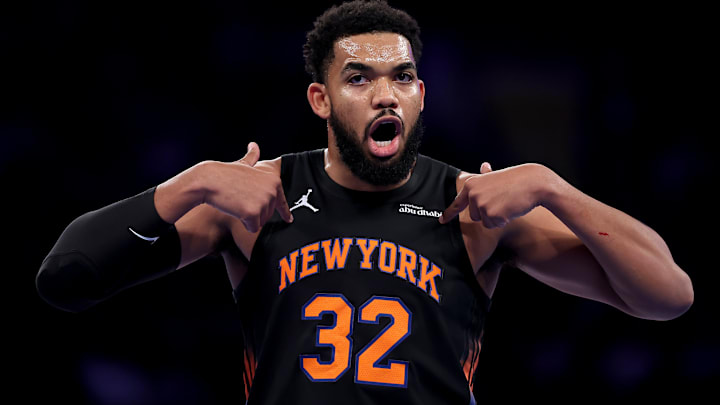
Somewhat quietly, the New York Knicks have moved away from starting Karl-Anthony Towns alongside Mitchell Robinson when both are available. And while getting more tick at center, KAT has largely looked like a different player—a better, rejuvenated player.
Raise your hand if you’re surprised.
This is not a development that should overwhelm you with shock. Putting Towns at center is the entire point of having him. His floor-spacing and driving, specifically, are more valuable at the 5 than the 4. The Knicks never entirely punted on this concept, but they haven’t leaned fully into it, either. His utility is always caveated by the presence of another non-spacer, be it Robinson, or Josh Hart (more on him shortly).
Protecting Towns on defense is easier when he’s at power forward. Or rather, it’s supposed to be easier. Wonky play from Robinson on the less-glamorous end has brought that into question—laying the groundwork for a lineup tweak New York probably never should’ve needed to make.
Towns looks more comfortable on offense when playing center
When the Knicks play Towns alongside another center, he is averaging 26.8 points per 100 possessions, while hitting 44.1 percent of his twos and 33.3 percent of his threes. When he’s the only 5 on the floor, he’s putting up 34.2 points per 100 possessions, and canning 54.1 percent of his twos, as well 35.6 percent of his triples.
New York’s defense is, as expected, better during the dual-big stretches (Guerschon Yabusele not included). But it isn’t nearly stingy enough to justify displacing Towns from his best position.
See for yourself:
- Knicks with Towns at center: 125.3 offensive rating, 115.1 defensive rating
- Knicks with Towns alongside another center: 122.1 offensive rating, 113.5 defensive rating
This isn’t even a competition when looking at the returns.
The additional spacing that comes with KAT at the 5 is inherently more dangerous. The Knicks aren’t just stretching defenses further outside the paint; they are giving Towns more of an opportunity to play at various levels of the floor.
Driving lanes aren’t as open with Robinson or another big in the half-court. Higher-quality paint touches are harder to come by. And Towns, while forever inconsistent no matter the context, isn’t as likely to be aggressive or pose a mismatch if he’s not forcing the other team to guard him with a center.
The Knicks can’t turn back now
Preserving the emphasis on KAT-at-the-5 lineups is the Knicks’ best chance at regularly optimizing their highest-paid player—and themselves. Sure, head coach Mike Brown is free to futz and fiddle depending on matchups. Stubbornness is more detrimental than flexibility, or experimentation.
Still, it’s never been harder to buy into Towns-plus-another-big looks for this team. It’d be different if Robinson was delivering dominant defense night in, and night out. He’s not. OG Anunoby is proving far more integral to insulating Towns—and everyone else.
New York needs to lean further into this identity. Altogether ditching dual-big minutes is an extreme, but they should be less of a focus, never mind a potential default.
This brings us to the Josh Hart of it all. Last year’s starting lineup featuring him is back, and performing much better, largely thanks to hotter three-point shooting from the Knicks, and colder outside accuracy from opposing offenses. If this is a new normal, the team has nothing to think about. Hart might invite some defenses to guard Towns with a small, but the quintet is currently putting enough pressure on them to enjoy the intended benefits of KAT-at-the-5.
If and when that changes, the Knicks must adjust accordingly, with the endgame remaining a system built around Towns playing center—any potential defensive concessions, at this point, be absolutely damned.
 Add us as a preferred source on Google