

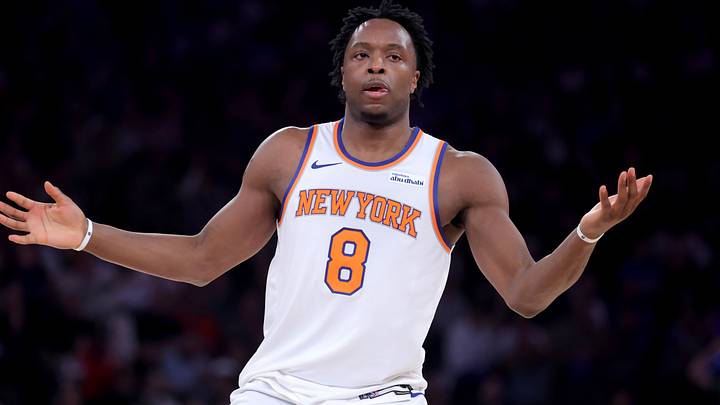
After making over 39 percent of their three-pointers during last year’s playoff run, the New York Knicks are internally worried about experiencing a drop-off in 2026-27. History says they’re right to brace themselves for regression.
History also suggests the Knicks have room to withstand a dip, and still put forth a valiant title defense.
Earlier this offseason, “a team source took a cautious approach” when speaking with ESPN’s Ben Golliver, “warning about the possibility of a championship hangover, and noting that the Knicks' three-point shooting could regress next spring after they ranked first in the 2026 postseason.”
Color yourself every shade of unbothered by the prospect of a “championship hangover. Jalen Brunson is not wired like that…at all. So, the same goes for the rest of the team, too.
The three-point shooting is a different story. But not a damning one.
The Knicks’ outside shooting will almost assuredly take a hit
Reigning champions historically experience a decline in long-range accuracy. The previous 20 title winners have seen their regular-season three-point efficiency fall by 0.2 percentage points relative to the league average.
While that isn’t much, the gap widens once you get to the playoffs. The last 20 champions have seen their postseason conversion rate from beyond the arc tumble by a full percentage point relative to the league average.
Reasons for the downswings vary. Rosters undergo changes. Deep playoff runs can lead to fatigue the following year. Injuries happen. Then, of course, there’s raw volatility.
None of these factors leave the Knicks above prospective regression. They are not an injury-prone team at the top, but with so many guys in their 30s, they could be due for a setback. Fatigue is a real risk. Blowing through the 2026 playoffs could help, but Brunson, Josh Hart, and Mikal Bridges each rank in the top five of total minutes logged over the past four years. OG Anunoby is 16th.
New York does boast a ton of roster continuity. Even after losing Mitchell Robinson to Boston, the Knicks are returning more than 85 percent of last year’s regular-season minutes. Yet, this historically hasn’t mattered.
Look at how the most recent reigning champions have fared relative to the league average in their title seasons versus the following year:
- All champions (20 teams): -0.2 change (-1.0 in playoffs)
- 70-plus percent roster continuity (18 teams): -0.2 change (-0.8 in playoffs)
- 85-plus percent roster continuity (11 teams): -0.7 change (-1.2 in playoffs)
Defending champs with as much or more roster continuity than the Knicks have actually fared worse. This isn’t enough to declare it a trend, though it could signal that an over-reliance on the same players is dangerous. More likely than not, it’s just your standard, run-of-the-mill volatility—which neither guarantees or precludes New York’s shooting from dropping off.
New York’s 3-point performance last year gives it room to breathe
For posterity’s sake, let’s operate under the assumption the Knicks will see their three-point percentage dip significantly in 2026 compared to 2027. They were so lethal from behind the rainbow it might not matter.
With a 39.1 percent hit rate on triples, New York was 4.3 percentage points better than the NBA’s 34.8 percent playoff average. The typical champion from our sample of 20 was a plus-1.3 in this department. That means the Knicks’ advantage from distance was more than three times the average.
Expecting to maintain this pace is beyond unrealistic. OG Anunoby (48.9 percent), Landry Shamet (47.5 percent), and Karl-Anthony Towns (45.6 percent) all cleared 45 percent from a different area code while logging over 300 total postseason minutes. They are prime candidates for material regression.
Still, even if the Knicks follow the (loose) trend for reigning champs with 85-plus percent of last year’s minutes coming back, they’d remain elite. Again, on average, those 11 title winners saw their postseason efficiency from deep fall by 1.2 points relative to the league average. Suffering an identical blow would leave New York 3.1 percentage points above the postseason average—still more than double the average champion’s performance.
Phrased another way: The Knicks’ shooting was so good when it mattered most last year that they have the ability to get substantially worse, and win it all again anyway.
 Add us as a preferred source on Google