

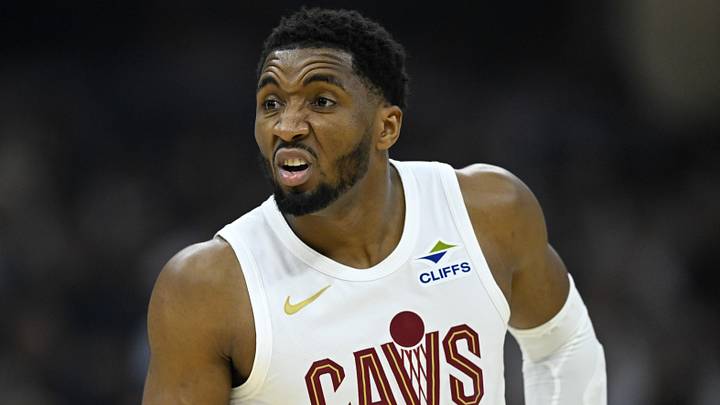
Of the many adjustments the New York Knicks made in Game 1 against the Cleveland Cavaliers, the decision to have Landry Shamet guard Donovan Mitchell isn’t receiving enough attention. While a surface-level tweak upon first consideration, it’s actually a wrinkle with downstream ramifications for which Cleveland has no answer.
Shamet ended up spending more time opposite Mitchell than anyone else on the Knicks. On those occasions, the Cavs offense as a whole averaged just 0.81 points per possession. That alone validates the proof of concept.
Except, this isn’t just about Shamet hanging with Mitchell. (He did.) It’s about what it does for the rest of the Knicks defense, and how difficult it is for Cleveland to counter.
Putting Landry Shamet on Donovan Mitchell has trickle-down effects
Tying Shamet to Mitchell also coincided with New York putting Karl-Anthony Towns on Evan Mobley, and moving OG Anunoby to Jarrett Allen. As Caitlin Cooper of Basketball, She Wrote pointed out when the Toronto Raptors threw Jakob Poeltl on Mobley in Round 1, this approach invites Cleveland to use Mobley as the screener rather than Jarrett Allen.
Being rather skinnier, Mobley’s picks aren’t as difficult to fight around. And Shamet just so happens to be one of the Knicks’ scrappier screen navigators. That limits how often New York concedes switches in Mitchell pick-and-roll actions. He isn’t going to call on Allen to set a pick, since that brings Anunoby in the action.
Cleveland will try getting back to Mitchell vs. Jalen Brunson by setting off-ball screens. The efficacy rate on those won’t be very high if JB is guarding Sam Merrill, Dean Wade, Max Strus, Dennis Schroder, et al. Whether it’s Mitchell or one of the others setting the screen, Shamet will have little trouble navigating those.
Faced with suboptimal Mitchell circumstances, the Cavs will default to more James Harden running the offense. Given the way Harden is playing, how slow he’s looked, and the fact that Mikal Bridges continues to box people into coffins, this is a win for New York. Cleveland is still inclined to use Mobley as the primary pick-setter to go after KAT. That’s an easier screener for Bridges to navigate.
The Cavs can look to target Brunson by using Harden to screen his man. They tried that in Game 1, and it didn’t work.
For all of his physical limitations, Brunson can be a worker bee on defense. He has a better chance of keeping up with Harden than he does Mitchell. The Beard is 36, and more apt to settle for jumpers than attack the basket if he’s not working with a big-man roller or popper.
The Knicks may have put the Cavs in a situation they can’t solve
To be sure, Shamet-on-Mitchell may not always go the Knicks’ way. Spida can hit ridiculously contested shots when he gets going.
Conceding switches with Brunson on any ball-handler is also a dicey proposition. If the Cavs lean into Harden screening JB’s man, it puts pressure on players like Bridges or Shamet to provide more gap help.
Oh, and we haven’t even gotten to the Josh Hart of it all. Shamet guarding Mitchell alongside the Knicks’ other starters requires moving away from Hart when the situation calls for it. That’s not nothing. But Mike Brown has not shied away from tough rotation decisions in the past, even if it takes too long for him to make them. Hart is also willing to take a back seat when it leads to victory, like it did in Game 1.
More wins will follow suit for the Knicks if they’re willing to play the Shamet-on-Mitchell card earlier, and more often. Try as they might, the Cavs don’t have the personnel to nudge New York out of this comfort zone unless they move away from dual-big units or, more extremely, Harden himself.
 Add us as a preferred source on Google