

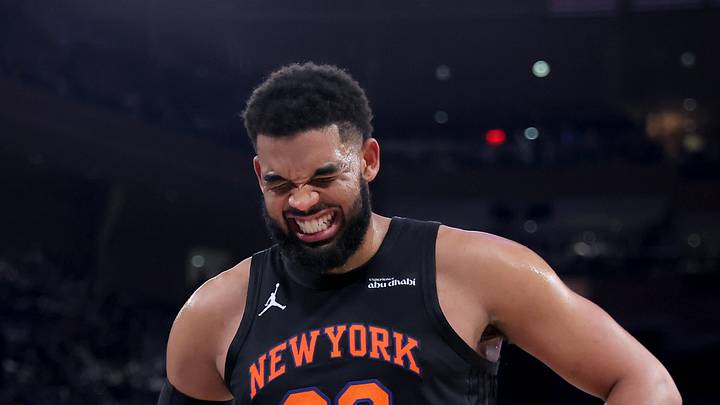
Despite pulling out a Game 2 victory and seizing the 2-0 series, the New York Knicks saw a notable shift from the Philadelphia 76ers that could flip the script if they’re not careful: Paul George guarding Karl-Anthony Towns.
Opposing teams putting wings on KAT is nothing new. It has become one of the most talked about wrinkles since last season, largely because it’s often so effective.
More recently, the Knicks and Towns have gotten better at adjusting, sometimes undermining, this adjustment. But PG taking on the KAT assignment in the fourth quarter of Game 2 is worth clocking—because it is relatively new, and above all, because it worked.
The Knicks did not have a consistent answer for Paul George guarding Karl-Anthony Towns
Prior to this series, George spent a total of 30 possessions since last season as the primary defender on Towns. That isn’t a large enough sample to take away much of anything.
The same technically goes for the fourth quarter of Game 2. Yet, because of how central Towns has become to jump-starting New York’s offense, his relative dissociation from the final frame’s attack is unsettling.
While playing nearly the entire fourth, Towns attempted just two shots, missing both. None of those looks came during crunch time. He did have two assists in the period, but also committed two turnovers, and the Knicks weren’t able to generate as many touches for him.
George’s impact was starkest on the lost-ball turnover KAT committed with around 7:25 to go. New York tried to get him the ball up top, where he’s been facilitating a lot of the offense. PG came from behind to break up (a rather telegraphed pass) from Jalen Brunson, leading to a transition opportunity for Philly.
This is what putting a capable wing on Towns can do. Not only does it eat into his role as a screener, but it becomes harder for the Knicks to get him hassle-free frontcourt touches outside the paint.
New York needs to be ready for more PG on KAT
Fortunately for New York, Philly isn’t built to give George the full-time KAT assignment. As much as he mucks up Towns’ top-of-the-key/above-the-arc touches, he doesn’t have the body to hold up in the post. Especially when he has to ferry a prominent offensive workload, with or without Joel Embiid.
The Knicks proved as much in the lone instance it got KAT the ball on the block. With 9:09 to go in the fourth, he overpowered George, creating what should have been a dunk (which he missed). New York can and should default to more of that if the Sixers keep pressing the PG-on-KAT button.
Of course, this is part of the concern. The Knicks have struggled to keep Towns involved during fourth quarters and crunch time on a consistent basis. Some of that is a Brunson-or-nothing mindset. Much of it, however, can be tied to matchups. New York is more inclined to have Josh Hart screen for ball-handlers to put the other team’s big man in the action.
This shouldn’t have been an issue in Game 2. The Sixers did not have Embiid, and ran out Dominick Barlow-at-the-5 units. Countering the PG-on-KAT gimmick was theoretically easier than the Knicks made it.
It may not be so straightforward in Game 3. The calculus changes if Embiid plays. With or without him, though, the Sixers are bound to bust out the PG-versus-KAT matchup again. New York needs to be ready—better prepared to find ways of getting Towns touches down low, or limiting his exposure to PG on the perimeter.
 Add us as a preferred source on Google