

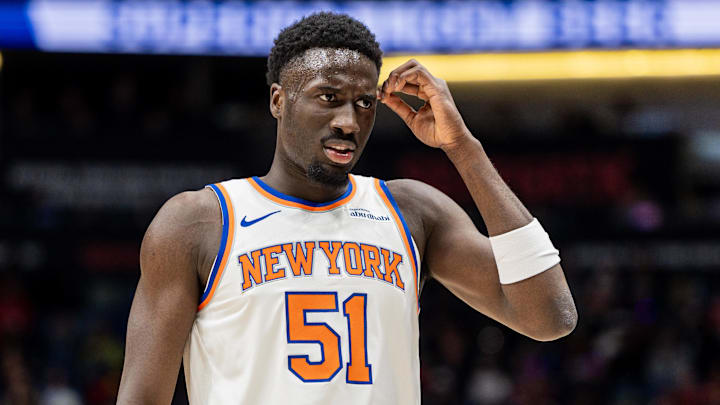
Mohamed Diawara’s rookie season has been a dream for the New York Knicks. Ahead of the playoffs, though, a tough-to-stomach reality is setting in: His shot-making may have been a mirage, and it could cost him his spot in Mike Brown’s rotation.
Zero red flags spring up when taking in Diawara’s entire season. He is shooting 40 percent on surprisingly high per-minute volume. It doesn’t matter that the majority of his triples have gone uncontested. Making the shots that defenses concede is a skill. Diawara’s accuracy exceeds even the wildest preseason hopes, and has allowed New York to capitalize on his defensive versatility as it sees fit.
In recent weeks, however, the honeymoon from long distance has come to a sudden, potentially concerning end.
Mohamed Diawara is struggling to make shots
Over his past 12 games, Diawara is draining 34.5 percent of his three-pointers (10-of-29). Rewind the clock to October, and even that clip obliterates initial expectations. It only feels low because of the glimpses into better accuracy the newbie has provided.
At the same time, 34.5 percent isn’t good enough when you’re trafficking in a large share of unguarded treys. Diawara’s shaky clip has also coincided with a dip in volume. His 6.4 three-point attempts per 36 minutes during this stretch pale in comparison to the 8.0 he was firing up prior to it.
It likewise doesn’t help that the rookie is barely shooting 40 percent from inside the arc (11-of-29) over these past 12 games. He has never been a high-volume two-point shooter, owed largely to his role as an off-ball spacer. And while he’s shown flashes of a floor game, the 48 percent he’s shooting inside the arc for the year isn’t high to begin with.
Dropping off even further, amid topsy-turvy finishing near the basket, makes it harder to carve out minutes for him when his threes also aren’t going down. His role over this span reflects as much. Diawara was averaging over 15 minutes in his previous 12 games. That has dipped to 13.5 minutes through the past 12 tilts.
It’s not as if the Knicks have been healthier, either. Deuce McBride only came back for a hot second. Landry Shamet is on the shelf as we speak. And Josh Hart even missed some time during this stretch.
Diawara isn’t guaranteed a spot in the Knicks’ playoff rotation
A portion of would-be Diawara minutes have gone to smaller alignments, with a noticeable uptick in court time for Jordan Clarkson. That says all you need to know about the Knicks’ priorities. They are going to favor the prospect of offensive dynamism over defensive versatility.
This isn’t just a Diawara issue. Jose Alvarado has seen his usage fluctuate amid a colder streak. Relative to their respective roles, Diawara’s has actually remained more intact.
Still, the rookie’s two-minute stint in New York’s loss to the Oklahoma City Thunder was nothing if not an eye-opener. They didn’t pretend to guard him, he didn’t get a single shot off, and the Knicks didn’t go back to him after Mike Brown pulled him.
That isn’t so much unfair or tough love as a snapshot of New York’s reality. Margins for error are finite when you’re contending for a title, and certainly in any given game against OKC. So while the Knicks’ stomach for Diawara’s shot-making may vary in the regular season, he’ll be facing a hit-or-miss runway once the playoffs tip off.
There will be moments in which that doesn’t play out in his or New York’s favor. That doesn’t mean Diawara must be subject to profound skepticism. He’s still banging in over 38 percent of his spot-up threes during this “slump.” His 1-of-5 clip on pull-up triples drags down the overall hit rate.
But razor-thin swings mean everything in the postseason, which is its own small sample. If Diawara is anything less on offense than what he’s been at his peak, the Knicks may be forced to react accordingly, surrounding injuries and all: by cutting his minutes, if not his spot in the rotation altogether.
 Add us as a preferred source on Google