

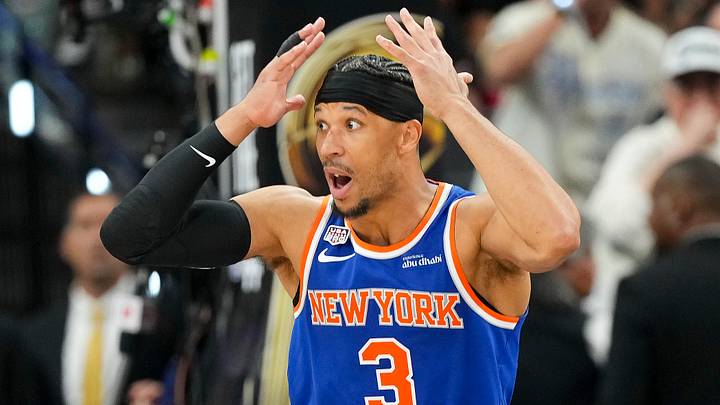
Karl-Anthony Towns seems less likely to sign an extension with the New York Knicks before the start of the 2026-27 season. By default, this also means Josh Hart will not be getting a new deal, either.
Shams Charania of ESPN first brought word that the negotiations between the Knicks and their seven-footer have “stagnated.” He went as far as calling the potential for a deal entering training camp “unlikely.”
Ian Begley of SNY followed up with a report that “there’s been plenty of conversation” between Towns and New York, and that the team has “talked to Towns’ side about deals that start in [the] $45M-$50M range.” He notably did not refute Charania’s intel on a deal being unlikely.
As we have covered before, Towns passing on an extension isn’t the end of the world. There is even a scenario in which this is better for New York. But without Towns putting pen to paper on a new pact, the Knicks can’t afford to lock in Hart beyond this season.
The Knicks need Towns’ future salary so they can negotiate Hart’s next payday
Everything about the Knicks’ future comes back to the second apron. Our assumption is that they won’t pay into it. So long as that remains the case, they will be trying to work below it while keeping the starting five together for as long as possible.
Towns’ extension will go a long way toward determining how long that’s actually possible. Right now, his $61 million player option for 2027-28 leaves the Knicks inside $3.7 million of the second apron, with only 10 players on the books. That number needs to come down if New York wants to retain Miles McBride, access the mini mid-level exception, and/or increase flexibility on the trade market.
Much of the same can be said about Hart. He has a $22.4 million team option for 2027-28. Whether the Knicks can pay him that much (or more) and remain beneath the second apron depends almost entirely on what Towns’ number will be.
Let’s say KAT doesn’t take a discount. New York probably needs Hart to lower his salary in that scenario. On the other hand, if Towns does take a cut from his $61 million player option, it gives the Knicks more room below the second apron—flexibility they can reallocate to Hart, McBride, potentially even free agents (i.e. mini-MLE candidates).
This calculus changes in the event Hart is offering to take a sizable discount himself. But the Knicks can’t count on it. He already helped them out when he signed the deal he’s currently on. Though he’s not going to ask for his max (four years, $131.2 million), his salary is low enough that he may not be offering to chop off $5 million or more per year as part of a new agreement.
On top of all that, without Towns under lock and key beyond this season, New York needs all the flexibility it can get. At the moment, the front office has the ability to rework Hart’s 2027-28 salary by declining his team option, and brokering a new deal. The Knicks will lose that optionality once the ink dries on a Hart extension.
There’s still time for all of this to change. Towns might sign an extension after all. If he doesn’t, well, he won't be alone. Josh Hart probably won't be getting one, either.
 Add us as a preferred source on Google