

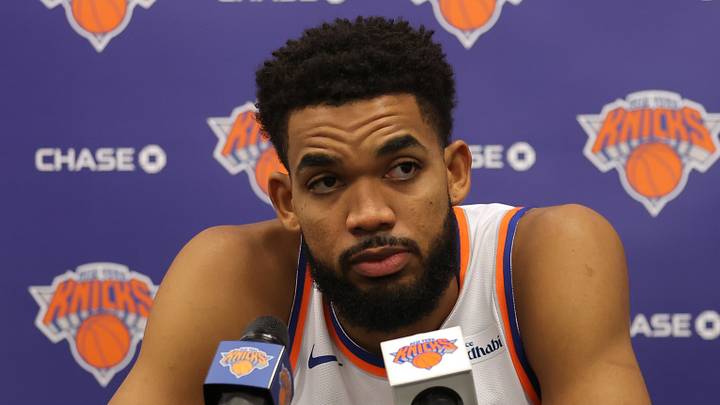
The New York Knicks reportedly offered Karl-Anthony Towns a four-year, $200 million contract extension—a figure that's $77 million below the max. In response, Towns reportedly told Stefan Bondy of The New York Daily News the following: " I want to do something to keep the team together and can work with the Knicks and also values me. And none of those things are close to happening.”
Though Towns' frustration is understandable, the Knicks are in an impossible position as they look to keep a championship team with players in or approaching their 30s together despite their massive contracts, the lack of ideal depth behind them, and the way the second apron limits flexibility.
Two realities are currently coexisting in New York. One is that Towns is a six-time All-Star who just played the best defense of his career and operated as the interior anchor as the Knicks won their first championship in 53 years.
The other is that the second apron is a merciless factor that the Knicks would be foolish to ignore when handing out a four-year contract—particularly when they have massive dollar amounts tied up in so many players already.
Towns' extension would conceivably kick in during the 2027-28 season. As it stands, the Knicks are already due to pay OG Anunoby $45,431,034, Jalen Brunson $40,535,041, and Mikal Bridges $36,160,714. Josh Hart also has a $22,375,280 team option and may ultimately sign an extension himself.
With the Knicks already facing questions in regard to their depth with Miles McBride in a contract year and Mitchell Robinson already departing for financial reasons, extending Towns isn't as simple as it seems.
Knicks should pay Karl-Anthony Towns—but it's not a simple negotiation
Towns will turn 32 just a month into the first season on his potential extension. By the end of that campaign, Hart will be 33, Bridges and Brunson will be roughly two months shy of turning 32, and Anunoby will be about a month away from his 31st birthday.
This by no means is meant to suggest that the Knicks should let players walk, but it absolutely speaks to how complicated the negotiations with Towns truly are.
Towns will be 35 at the end of a potential four-year extension and his teammates will be in the same age range as him. Furthermore, Anunoby and Brunson have player options for the 2028-29 season and will likely negotiate lucrative extensions of their own.
Compounded by the fact that Bridges is signed through 2030, with a $41,517,856 player option for the 2029-30 campaign, New York could be paying big money to an aging core sooner than later.
Knicks need to find a path to sustainable depth as big contracts roll in
That puts immense pressure on Leon Rose and the Knicks to create sustainable depth. They signed Jose Alvarado and Landry Shamet to two critical team-friendly contracts, but the absence of proven up-and-comers is an unavoidable red flag.
Re-signing McBride, 26, could help to some extent, but even then, questions would persist along the wings and interior respectively.
Perhaps players such as Mohamed Diawara and Tyler Nickel will rise to the occasion and help the Knicks overcome this potential concern. Until that transpires, however, the Knicks are moving toward loading up on massive long-term contracts for 30-plus players with limited resources to supplement their talent or take pressure off of them.
Compounded by how demanding the roles and postseason minutes are for the starters, paying Towns more than $200 million across four seasons isn't quite as simple as it seems.
 Add us as a preferred source on Google